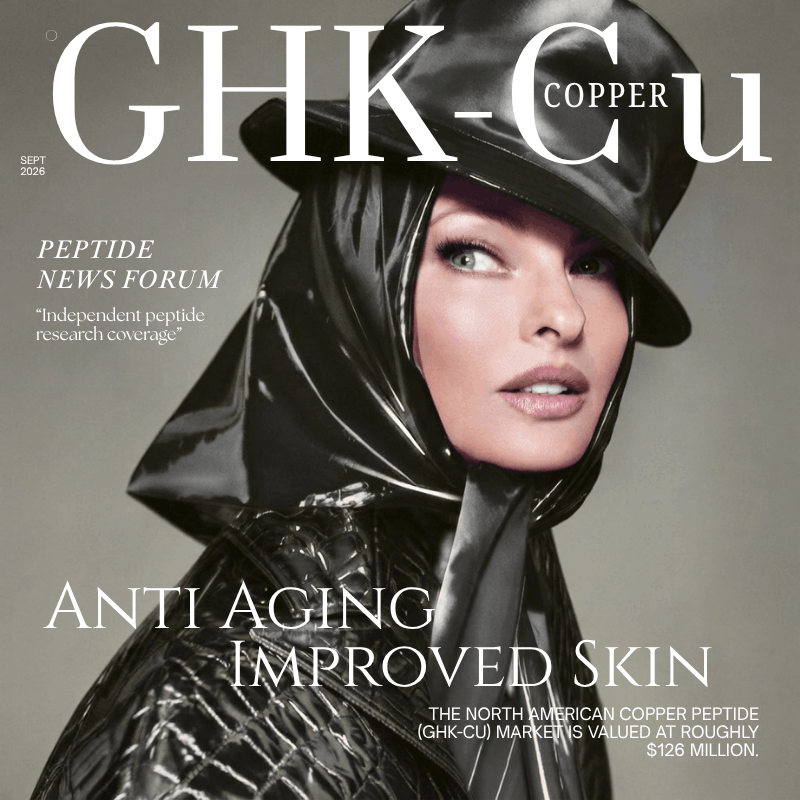
Copper peptide, or GHK-Cu, is arguably one of the most widely used ingredients in beauty care across the USA today. What makes this surprising is that despite its popularity, it has never received FDA approval as a drug. Copper peptide isn’t found in food products at all. Instead, it shows up almost exclusively in skincare, most commonly in what’s marketed as copper peptide serum, where brands promote it for its anti-aging properties.
Key Takeaways
- The North American copper peptide (GHK-Cu) market is valued at roughly $126 million.
- Assuming an average annual spend of $400 to $800 per consumer on products containing GHK-Cu (such as standard anti-aging or hair serums), this points to a massive consumer base.
- GHK-Cu, or copper peptide, has never received FDA approval as a therapeutic drug, despite research dating back to 1973.
- Real scientific research exists on GHK-Cu’s wound-healing and anti-inflammatory properties, but it hasn’t reached the scale of evidence FDA drug approval requires.
- The main reason is economic: as a naturally occurring molecule, it’s difficult to patent, removing the financial incentive for a company to fund expensive clinical trials.
- Topical cosmetic use is legal and widely available; injectable use is not FDA-approved and carries limited safety data.
- According to 2026 digital analytics, GHK-Cu captures a steady monthly search volume of roughly 18,100 targeted searches in the U.S. specifically looking for the peptide compound.
- So, the number of copper peptide user in the USA is no less then 10,000 in the USA.
- Surprisingly, Copper peptide, technically known as GHK-Cu is not FDA approved yet.
- Injectable GHK-Cu was removed from the FDA’s Category 2 list simply because its nominators withdrew their submissions, not because it was approved.
- It was “Do Not Compound” (category 2 ) list on April 2026, purely due to a retracted petition, not because the FDA cleared its safety risks.
Copper Peptide
Copper peptide, technically known as GHK-Cu, has been sitting on skincare shelves for decades and generating real scientific interest since the 1970s. Yet despite all that history, no FDA-approved copper peptide drug exists. This isn’t because the science is fake or the peptide doesn’t do anything. The real reasons are more about economics and evidence gaps than about the molecule itself.
At a Glance
GHK-Cu, commonly called copper peptide, has never received FDA approval as a therapeutic drug, even though it’s been studied since 1973 and is widely sold as a cosmetic ingredient. The main reason isn’t weak science, it’s that GHK-Cu is a naturally occurring molecule, which makes it difficult to patent, and without patent protection, no drug company has an economic incentive to fund the expensive clinical trial process required for approval. Meanwhile, a newer trend of injecting copper peptide, rather than applying it topically, has moved faster than the safety research behind it.
What Is Copper Peptide (GHK-Cu)?
GHK-Cu stands for glycyl-L-histidyl-L-lysine bound to a copper ion, a small tripeptide made from three amino acids that naturally binds copper. It was first identified in human plasma in 1973 by biochemist Loren Pickart, who found it while studying why serum from younger people seemed to encourage tissue regeneration more effectively than serum from older people.
The peptide occurs naturally in your body, in blood, saliva, and urine, and its levels decline with age. Research shows plasma levels average around 200 nanograms per milliliter in someone’s 20s, dropping to roughly 80 nanograms per milliliter by age 60. That age-related decline is part of why researchers connected it to wound healing and skin aging in the first place.
What Copper Peptide Is Actually Approved For Right Now?
This is where things get genuinely nuanced, because “not FDA-approved as a drug” doesn’t mean copper peptide exists completely outside any regulation.
- Topical cosmetic products containing GHK-Cu are legal and widely sold. They’re regulated as cosmetic ingredients, a lighter regulatory category that doesn’t require premarket approval, but also doesn’t allow the product to claim it treats or cures a disease. This is the same category most skincare active ingredients fall into.
- Non-sterile topical compounding of GHK-Cu currently sits on the FDA’s 503A Bulks List under Category 1, meaning it’s under active evaluation but currently allowed for compounding pharmacies to use in non-sterile topical formulations.
- Injectable GHK-Cu is a different story entirely. It is not FDA-approved as a drug, and current guidance identifies limited human safety data along with potential immunogenicity risk, meaning a possible unwanted immune reaction, for compounded injectable versions.
So Why No FDA-Approved Drug? The Real Reasons
It’s a Naturally Occurring Molecule, and That Creates a Patent Problem
This is the biggest reason, and copper peptides have more to do with business than biology.
GHK-Cu naturally occurs in the human body. Because of this, companies generally cannot patent the molecule itself like they can patent a new, artificially designed drug.
Researchers who have studied this issue have pointed out another problem. Without a unique, patentable version, pharmaceutical companies have little financial incentive to fund large FDA clinical trials. A competitor could potentially sell the same unpatented molecule after researchers prove that it works.
The FDA approval process can take years and cost hundreds of millions of dollars. Our guide to how the FDA regulates peptides covers this process in more detail.
Without patent protection, most companies may struggle to recover that investment. This makes GHK-Cu less attractive as a traditional pharmaceutical drug.
Real Research Exists, But It Hasn’t Reached the Scale FDA Approval Requires
It’s worth being fair here: GHK-Cu isn’t some fringe idea with zero science behind it. Decades of laboratory and animal research have explored its role in wound healing, collagen production, and anti-inflammatory activity. One notable 2012 study even flagged it as a promising candidate for reversing certain gene-expression changes linked to emphysema in COPD patients.
Dermatologists and researchers have raised concerns about this shift. Injecting a compound creates different risks than applying it to the skin. An injection can also expose the body to the compound in ways that topical use does not.
Human safety data on injectable GHK-Cu remains limited. Regulators have also flagged potential immune reactions from compounded injectable versions.
In short, people have started using injectable copper peptide faster than researchers have established its safety for this specific use.
The Cosmetic Market Already Makes It Profitable Without Drug Approval
Here’s a straightforward business reality: GHK-Cu has become a genuinely successful cosmetic ingredient, appearing in serums and creams that range from budget drugstore products to premium formulations selling for well over $100. Some market analyses project the copper peptide ingredient market could reach roughly $250 million by 2033.
When a compound is already generating solid revenue as a lightly regulated cosmetic ingredient, there’s simply less business incentive to pursue the far more expensive and risky drug approval pathway, especially without patent protection to make that investment worthwhile.
A New Injection Trend Is Moving Faster Than the Safety Research
This is the newest wrinkle in the copper peptide story. GHK-Cu has traditionally been used topically, applied to skin as a cream or serum. Recently, driven partly by online wellness and “looksmaxxing” trends, people have started injecting it instead, hoping for stronger effects than a topical product can achieve.
Dermatologists and researchers have raised concerns about this shift. Injecting a compound creates different risks than applying it to the skin. The injection can also expose the body to the compound in ways that topical use does not.
Human safety data on injectable GHK-Cu remains limited. Regulators have also raised concerns about possible immune reactions from compounded injectable versions.
In short, interest in injectable copper peptide has grown faster than the safety research supporting this specific use.
Comparing Copper Peptide’s Different Regulatory Categories
| Form | Regulatory Status | What This Means |
|---|---|---|
| Topical cosmetic (creams, serums) | Regulated as a cosmetic ingredient | Legal, widely sold, no disease-treatment claims allowed |
| Non-sterile compounded topical | FDA 503A Bulks List, Category 1 | Under evaluation, currently permitted for compounding pharmacies |
| Injectable | Not FDA-approved | Limited human safety data, flagged immunogenicity concerns |
| Full FDA-approved drug | Does not exist | No company has completed the required clinical trial program |
Is Copper Peptide Banned or Restricted Anywhere?
No, One important contrast often causes confusion. GHK-Cu does not currently appear on the World Anti-Doping Agency (WADA) prohibited list. This makes it different from BPC-157, which WADA bans under its “non-approved substances” rule.
However, an athletic ban does not mean FDA approval. These organizations answer different questions. WADA focuses on substances prohibited in sport. The FDA focuses on whether a substance has approval for medical use.
What This Means for Consumers?
The main point is not that copper peptide is dangerous or fraudulent. Its popularity in skincare products tells us little about its overall drug-safety profile.
The difference becomes more important when people change how they use it. For example, applying a product to the skin is very different from injecting it under the skin.
A cosmetic ingredient can have a long history of topical use without having proven safety for injection. These two exposure routes involve different risks.
Before considering an injectable form of copper peptide, or any peptide mainly sold as a cosmetic ingredient, talk with a doctor. A doctor can help explain what researchers have established and what remains uncertain.
Frequently Asked Questions About Copper Peptide GHK-Cu
Do Copper Peptides Regrow Hair?
The honest answer is: maybe, to a modest degree, but the evidence isn’t strong enough yet to call it proven. Copper peptide (GHK-Cu) has real, plausible science behind its connection to hair follicles, but most of that evidence comes from animal studies and small trials, not the kind of large, independent human research needed to say it definitively regrows hair. At the cellular level, research has shown GHK-Cu can increase hair follicle size and support the dermal papilla, the small structure at the base of the follicle that helps regulate hair growth.
Is copper peptide the same thing as copper supplements?
No. GHK-Cu is a specific tripeptide bound to copper, distinct from dietary copper supplements like copper bisglycinate, which work through entirely different mechanisms and regulatory categories.
Is it safe to use copper peptide skincare products?
Topical copper peptide cosmetics have been sold and used for decades within standard cosmetic safety regulations. That said, individual skin sensitivities vary, so patch testing new products is generally a reasonable precaution.
Why do some people inject copper peptide if it’s not approved for that?
Social media and wellness communities have mainly driven this trend. Many people seek stronger effects than topical products can provide. However, solid safety research on injectable use has not kept pace with this growing interest.
Will copper peptide ever get FDA approval?
It is possible, but some researchers consider it unlikely. The patent problem remains a major challenge. A company would need to develop a unique, patentable version of the compound. It would also need to fund a full clinical trial program on its own.
Does the lack of FDA approval mean copper peptide doesn’t work?
Not necessarily. Lack of approval reflects the absence of a completed. Large-scale clinical trial program, which is different from a claim that a compound has been tested and found ineffective.
Leave a Reply