KLOW Peptide Contraindications: Who Should Not Use It? and Why The Set of Contraindications Doesn’t Really Exist Yet
Related Terms:
KLOW peptide contraindications, is KLOW peptide safe, KLOW peptide blend side effects, GHK-Cu BPC-157 TB-500 KPV, unapproved peptide blends, Peptide Forum, Peptide Forums, research chemical peptides, who should not use KLOW
Key Takeaways
- KLOW is a blend of GHK-Cu, BPC-157, TB-500, and KPV, sold as a research chemical with no FDA approval and no human trials on the combination.
- “Contraindications” isn’t technically accurate for KLOW yet, since that term relies on clinical data that doesn’t exist for this product.
- Certain groups, including people with cancer history, autoimmune conditions, copper metabolism disorders, or pregnancy, face clearly elevated risk based on the individual ingredients.
- Combining four unapproved peptides adds interaction risks that haven’t been studied at all.
- Peptide Forums can be a source of community support, but they aren’t a substitute for clinical safety data.
- The safest starting point is a conversation with a licensed healthcare provider, not a forum thread or a seller’s product page.
If you’ve spent any time on a Peptide Forum lately, you’ve probably seen KLOose being discussed as a go-to blend for skin, recovery, and anti-aging. It’s a mix of four peptides sold under names like KLOW or “Klow Stack,” and it’s picking up popularity fast. But there’s an important gap between how it’s talked about online and what’s actually known about its safety.
This article looks at KLOW Peptide Contraindications honestly: what the blend actually contains, why the word “contraindications” doesn’t quite apply yet, and who faces the highest risk if they use it anyway.
What Is KLOW Peptide?
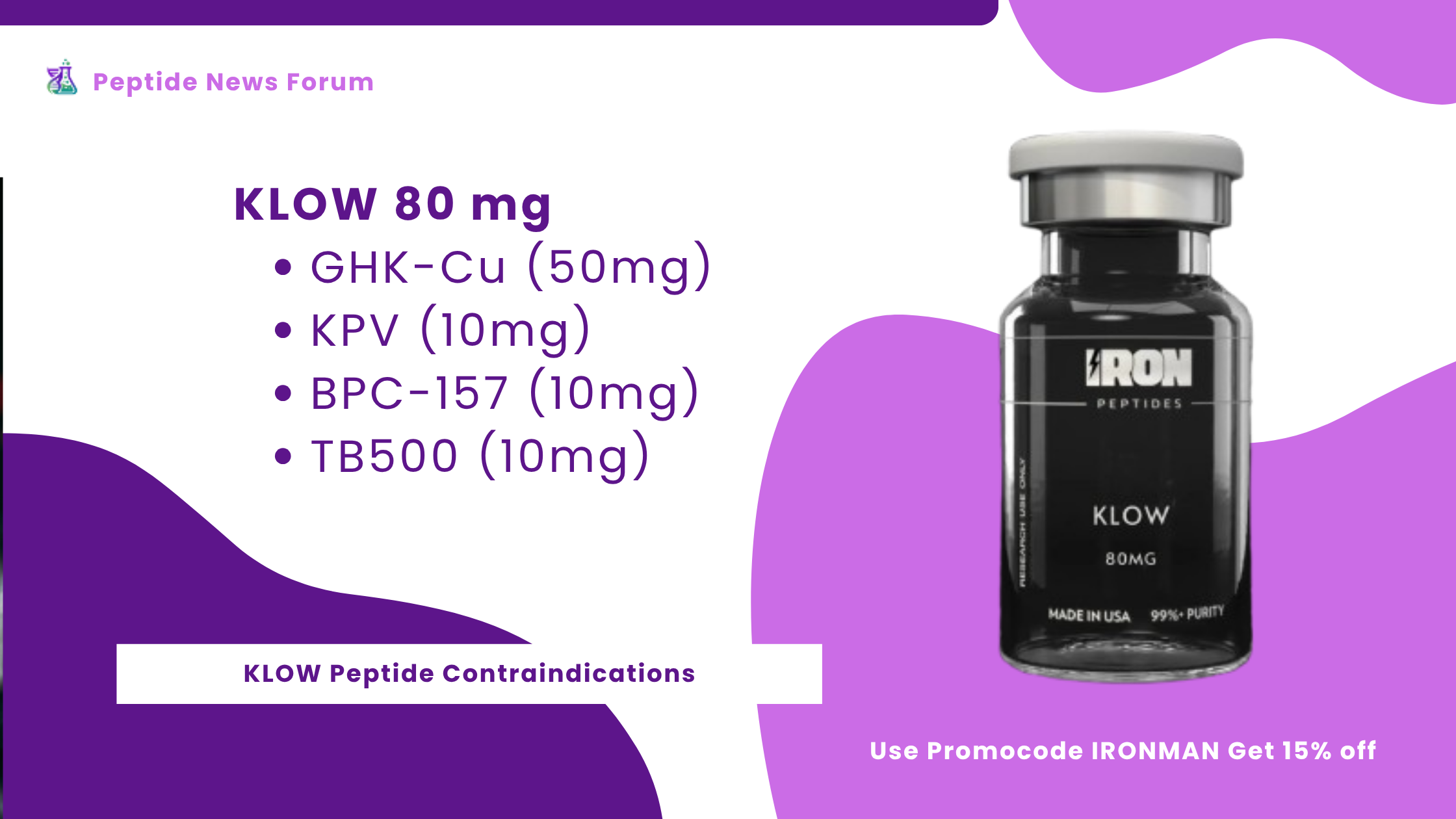
KLOW is a combination of four peptides in one vial:
- GHK-Cu (a copper-binding peptide, usually the largest portion of the blend)
- BPC-157 (studied mostly in animal models for gut and tissue repair)
- TB-500 (a fragment of thymosin beta-4, studied for wound healing)
- KPV (a small anti-inflammatory peptide)
It’s sold almost exclusively by “research chemical” suppliers, labeled “not for human or veterinary use.” In practice, people buy it for skin, joint, and recovery purposes despite that label. KLOW has not gone through any FDA review, and there are no published human clinical trials on the blend as a whole.
Why “Contraindications” Isn’t the Right Word Yet?
Contraindications are specific medical reasons a person shouldn’t take a drug, and they come from actual clinical trial data. Regulators identify them by watching what happens when real patients, across different ages, health conditions, and other medications, take the drug in controlled studies.
KLOW has never gone through that process. Neither has the combination of its four ingredients together. So when someone asks for “KLOW peptide contraindications,” the honest answer is that a real, evidence-based list doesn’t exist yet. What we can talk about instead is risk factors, meaning groups of people who face a higher chance of harm based on what’s known about the individual ingredients and how unapproved peptides behave in general.
This distinction matters. A tidy “who shouldn’t use it” list can accidentally suggest that everyone else is in the clear. That’s not true here. Nobody has an established safe profile for KLOW, because nobody has been formally studied using it.
What We Actually Know About Each Ingredient?
The evidence quality varies a lot across the four components:
- GHK-Cu has the most human research of the group, mostly in topical skincare studies, though injectable use is far less studied.
- BPC-157 has almost entirely animal and lab-based evidence. Human trial data is very limited.
- TB-500 is in a similar position, with most research coming from rodent studies rather than people.
- KPV has been studied mainly in lab and animal models of inflammation, not in human trials.
None of this means the ingredients are automatically dangerous. It means the safety margin, the dose that helps versus the dose that harms, hasn’t been mapped out in humans the way it has for an FDA-approved drug.
Risk Factors That Make KLOW More Dangerous for Certain People
Based on what’s known about the individual ingredients, some groups face a meaningfully higher risk than others:
| Group | What You Need to Know |
|---|---|
| Anyone with a current or past cancer diagnosis | BPC-157 and GHK-Cu both influence blood vessel growth and cell signaling, pathways relevant to tumor growth |
| Pregnant or breastfeeding individuals | No reproductive safety data exists for any of the four peptides |
| People with autoimmune conditions | KPV and BPC-157 affect inflammatory pathways, which could interact unpredictably with immune-related medications |
| People with Wilson’s disease or other copper metabolism disorders | GHK-Cu directly involves copper regulation in the body |
| People on blood thinners or with clotting disorders | BPC-157 is linked to changes in blood vessel and tissue repair activity |
| Minors | No pediatric safety data exists for this blend or its components |
| Anyone with known allergies to peptide-based products | Immune reactions to injectable peptides have been reported anecdotally |
Combining Four Peptides Multiplies and What it Changes?
Even if each ingredient individually had a solid safety record, which they don’t, stacking four of them together adds a separate layer of risk: interaction effects. Two substances can behave differently together than either does alone. Because KLOW as a combination has never been tested in a clinical trial, there’s no data on how these four peptides interact once they’re in the same body at the same time. That’s not a small detail. It’s one of the main reasons “research use only” labels exist in the first place.
A lot of what people believe about KLOW comes from a Peptide Forum or similar online spaces, where users share results, routines, and personal opinions. These peptide communities aren’t necessarily wrong to exist, and some members are genuinely trying to help others avoid mistakes. But a thread on Peptide Forums is not a safety study.
Nobody posting there is required to report side effects accurately. People who have a bad reaction often just stop posting rather than writing a detailed follow-up. And enthusiasm tends to get more attention than caution, so the loudest voices in a Peptide Forum are often the ones with the best (or most exaggerated) outcomes, not a representative picture of what actually happens to most users.
The Bottom Line Message
If there’s one message to take from this article, it’s this: the question isn’t really “who shouldn’t use KLOW,” it’s “has anyone established that it’s safe for anyone.” Right now, the honest answer is no. The risk factors above describe people who face amplified danger on top of an already unknown baseline, not a green light for everyone outside those categories.
Safer Steps If You’re Considering It
- Talk to a licensed doctor about your actual goal, whether that’s skin health, joint recovery, or something else, and ask what FDA-approved or well-studied options exist first.
- If you’re set on learning more, look for the individual ingredient research rather than marketing claims about the blend as a whole.
- Understand that “research use only” labeling exists for a legal and safety reason, not just as a formality.
- Be skeptical of dramatic before-and-after claims shared on a Peptide Forum, since they aren’t controlled or verified.
Frequently Asked Questions
Is KLOW peptide legal to buy?
It’s typically sold labeled “for research use only, not for human use.” Buying it is generally legal in that framing, but using it on a person falls outside that intended use and outside FDA-regulated channels.
Does KLOW have any official contraindications?
No. Contraindications come from clinical trial data, and KLOW as a blend has never been through human trials. Any “who shouldn’t use it” list is based on risk factors from its individual ingredients, not formal medical contraindications.
Are the individual ingredients in KLOW dangerous on their own?
Each has a different research profile. GHK-Cu has more human data, mostly from topical use. BPC-157, TB-500, and KPV rely mostly on animal studies, so their human safety profile isn’t well established.
Why do people trust advice from a Peptide Forum if it isn’t verified?
Forums can feel credible because they include detailed personal stories, but personal experience isn’t the same as controlled research. Reactions vary by person, and forums don’t reliably capture cases where something went wrong.
What should I do if I already used KLOW and feel unwell?
Contact a healthcare provider and tell them exactly what you used, including the source and ingredients, so they can evaluate your symptoms with accurate information.
Leave a Reply