The Definitive KLOW peptide Dosage Chart, Frequency, and Protocol
Disclaimer: This guide is strictly for educational and laboratory research purposes. KLOW and its components are Research Use Only (RUO) materials.
KLOW Peptide Dosage Calculator
Free Klow Blend Reconstitution Calculator by Klow Peptide
Peptide research gets confusing fast, especially with multi-peptide blends. Single-compound vials are simple. But the KLOW blend requires strict fixed-ratio math to ensure safe and accurate laboratory handling. This guide cuts through the conflicting “bro-science” online. We break down the exact reconstitution math, conservative titration schedules, and critical safety steps that other guides ignore.
Klow Peptide Dosage Chart
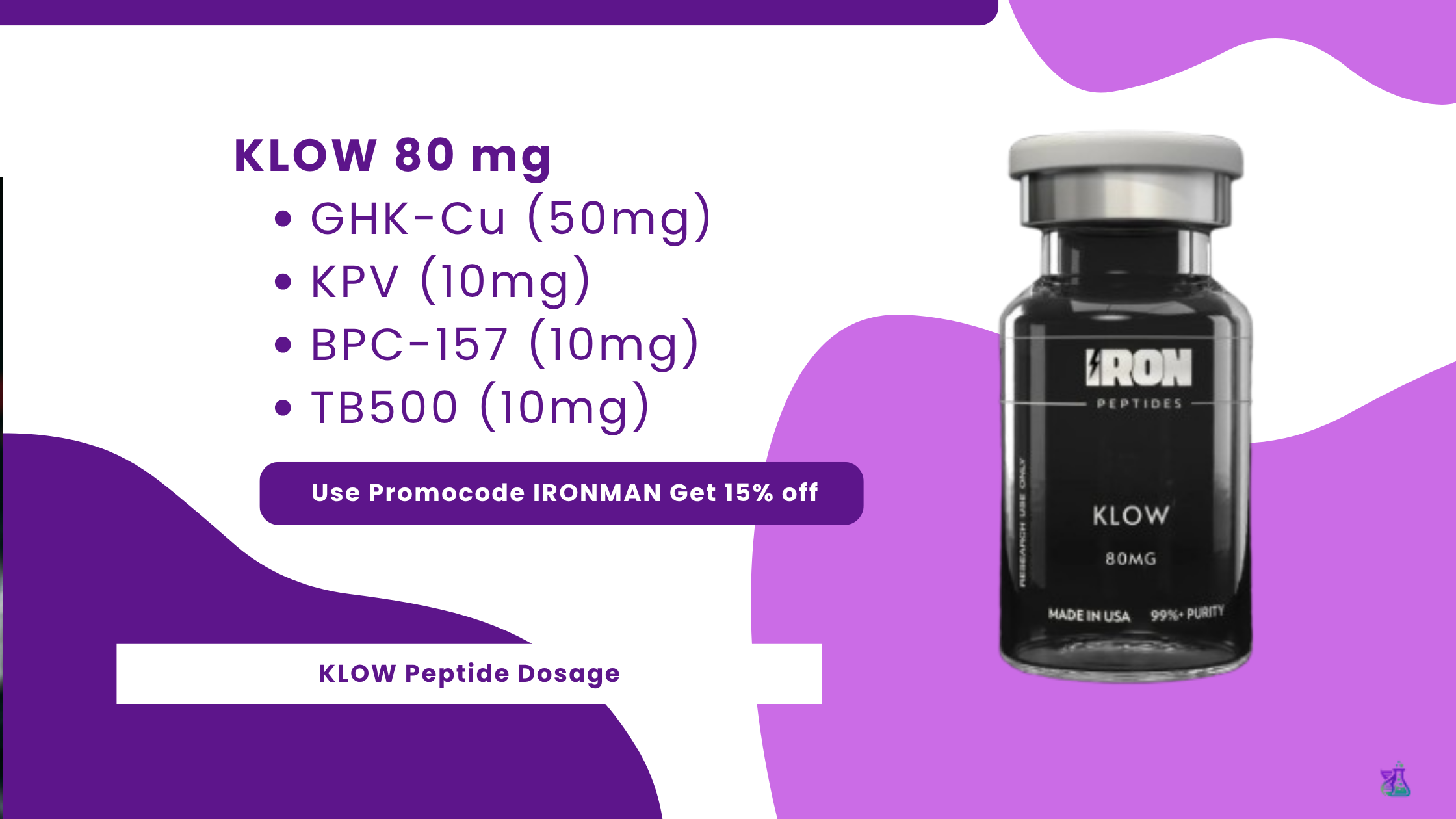
Researchers make one major mistake with this blend: they misunderstand its composition. KLOW is not a customizable stack. It is a pre-mixed, fixed-ratio blend totaling 80mg per vial. The standard ratio looks like this:
- 62.5% GHK-Cu (~50mg)
- 12.5% BPC-157 (~10mg)
- 12.5% TB-500 (~10mg)
- 12.5% KPV (~10mg)
The fixed ratio means every draw delivers all four peptides proportionally. You dose the total blend, but you must monitor the individual components. For example, if you target 500mcg of BPC-157, you simultaneously inject 2.5mg of GHK-Cu. That high GHK-Cu amount drives injection-site irritation.
Below is a standard reference table. It shows how reconstitution volume affects concentration and peptide delivery per standard insulin syringe draw (U-100).
| Bacteriostatic Water Added | Total Concentration | Per 5-Unit Draw (0.05 mL) | Per 10-Unit Draw (0.10 mL) |
|---|---|---|---|
| 2 mL | 40 mg/mL | 2.0 mg Total Blend (1.25mg GHK-Cu, 250mcg each of the others) |
4.0 mg Total Blend (2.5mg GHK-Cu, 500mcg each of the others) |
| 3 mL | 26.67 mg/mL | 1.33 mg Total Blend (833mcg GHK-Cu, 166mcg each of the others) |
2.67 mg Total Blend (1.67mg GHK-Cu, 333mcg each of the others) |
| 4 mL | 20 mg/mL | 1.0 mg Total Blend (625mcg GHK-Cu, 125mcg each of the others) |
2.0 mg Total Blend (1.25mg GHK-Cu, 250mcg each of the others) |
Pro Tip: GHK-Cu causes Post-Injection Pain (PIP). Experienced researchers reconstitute the 80mg vial with 3mL or 4mL of bacteriostatic water instead of 2mL. This lowers the concentration per unit and makes the injection much more comfortable without changing the total peptide amount.
Klow Peptide Dosage Protocol
Many online forums recklessly suggest aggressive “loading doses” of 4mg to 6mg right out of the gate. The high GHK-Cu content makes this a guaranteed recipe for severe injection-site burning, redness, and welts. A responsible protocol prioritizes tolerance testing before you scale up.
Klow Peptide Dosage Per Day for Beginners
If you are new to this KLOW Peptide blend, you must start low. The high GHK-Cu content can cause stinging, redness, or welts at the injection site. A conservative approach protects your tissue and helps you find your exact tolerance level.
Follow this simple, step-by-step guide for your first cycle:
- Step 1: Dilute it more. Reconstitute your KLOW Peptide 80mg vial with 3mL or 4mL of bacteriostatic water instead of 2mL. This dilutes the GHK-Cu and makes the injection much more comfortable.
- Step 2: Find your starting units. Aim for 1.0 mg of the total blend per day.
- If you used 4mL of water, 1.0 mg equals exactly 5 units on a standard U-100 insulin syringe.
- If you used 3mL of water, 1.0 mg equals roughly 3.5 to 4 units.
- Step 3: Follow a safe klow peptide dosage protocol.
- Weeks 1–2: Inject 1.0 mg once daily. Monitor the injection site for any redness or burning.
- Weeks 3–4: If you feel no irritation, you can slowly increase to 1.5 mg or 2.0 mg per day.
- Weeks 5–8: Drop back down to 1.0 mg, just 3 days a week. This gives your body a necessary break and prevents mineral imbalances.
Beginner Pro Tip: Always use a fresh, ultra-fine needle (31G or 32G) and push the plunger very slowly. This simple habit drastically reduces post-injection pain.
Optimizing Klow Peptide Dosage and Frequency
Once you establish tolerance, you can adjust the volume. You want to reach the therapeutic window seen in preclinical models for the individual components, while respecting the fixed ratio.
- Phase 2 (Weeks 3–6): Inject 1.5 mg to 2.0 mg of the total blend once daily.
- Phase 3 (Weeks 7–8): Taper down to 1.0 mg of the total blend, three times per week. This allows the body to reset and prevents receptor desensitization or mineral imbalances.
- Cycle Length: Run the cycle for 8 weeks on, followed by a minimum 4-week off period.
Klow Peptide Dosage per Day
Consistency matters in research. Keep a daily log of your exact unit draw, injection site, and any local tissue reactions. This data helps you pinpoint the exact volume that yields results without causing excessive PIP.
KLOW Peptide Side Effects, Safety, and What You Need to Know
Most guides list basic disclaimers, but they fail to address the practical realities of researching this specific combination.
Managing Post-Injection Pain (PIP)
GHK-Cu inherently irritates subcutaneous tissue. If you experience burning, do not push through the pain. Instead, increase the dilution (use more bacteriostatic water), use ultra-fine needles (31G or 32G), and inject the solution very slowly.
The Copper and Zinc Balance
GHK-Cu makes up 62.5% of this blend. Prolonged, high-volume research can theoretically alter systemic mineral homeostasis. Advanced research protocols account for this by pairing long-term GHK-Cu exposure with a low-dose zinc supplement (15–30mg). Take the zinc at a different time of day to maintain a healthy copper-to-zinc ratio. Almost no competitor guide mentions this critical detail.
Mythbusting: Why KLOW is NOT for Oral or Topical Use
Some lower-quality guides incorrectly suggest you can take the KLOW blend orally or apply it topically. This is dangerously misleading. Individual peptides have separate oral or topical research, but you must use the 80mg KLOW lyophilized blend exclusively for subcutaneous reconstitution. BPC-157 degrades rapidly in stomach acid without specialized enteric coating, and GHK-Cu highly irritates the gastrointestinal tract. Do not attempt to consume reconstituted KLOW orally.
Frequently Asked Questions About KLOW peptide Dosage
What Is the Dosage for Klow Peptide?
Because it is a fixed-ratio blend, you calculate the KLOW dosage based on the total milligram amount of the blend, not a single peptide. Researchers commonly start with 1.0 mg to 2.0 mg of the total blend per day, depending on the reconstitution volume.
What Is the Recommended Dosage for Klow Peptide?
There is no officially “recommended” human use of KLOW dose, as the compound is strictly for Research Use Only (RUO). However, based on preclinical data and harm-reduction principles, researchers typically start at 1.0 mg of the total blend daily. This assesses tolerance to the GHK-Cu component before you consider a gradual increase to 2.0 mg.
What Is Klow Peptide Dosage?
Every draw contains a fixed ratio. For example, a 2.0 mg draw of the total blend delivers approximately 1.25 mg of GHK-Cu, 250 mcg of BPC-157, 250 mcg of TB-500, and 250 mcg of KPV. You cannot isolate or adjust one peptide without adjusting the others.
What Is the Dosage of Klow Peptide per Day for Long-Term Cycles?
For extended research cycles beyond 6 weeks, you must reduce the daily volume to prevent potential copper accumulation. A maintenance phase involves dropping the dosage to 1.0 mg of the total blend, administered 3 to 4 days per week, followed by a mandatory 4-week washout period.
What Are the Possible Side Effects of a Klow Peptide Injection Site Reaction?
- Burning or stinging during or immediately after injection
- Redness (erythema) and mild swelling
- Itching or small, temporary welts
- Post-Injection Pain (PIP)
Why Is Klow Peptide Blue?
This is completely normal and is a visual indicator that the copper complex is present in the vial.
Final Thoughts
The KLOW blend is a powerful research tool, but its fixed-ratio nature demands precise math and conservative handling. Prioritize proper dilution to manage GHK-Cu irritation, respect the copper-to-zinc balance, and avoid reckless loading doses. These steps help researchers gather accurate and reliable data. Always store reconstituted vials in the refrigerator (2°C to 8°C) and discard them after 28 days.
Final Research Disclaimer: This article is for educational and laboratory research purposes only. It does not constitute medical advice, diagnosis, or treatment recommendations. Researchers intend all discussed peptides strictly for in vitro and preclinical research use.
Leave a Reply