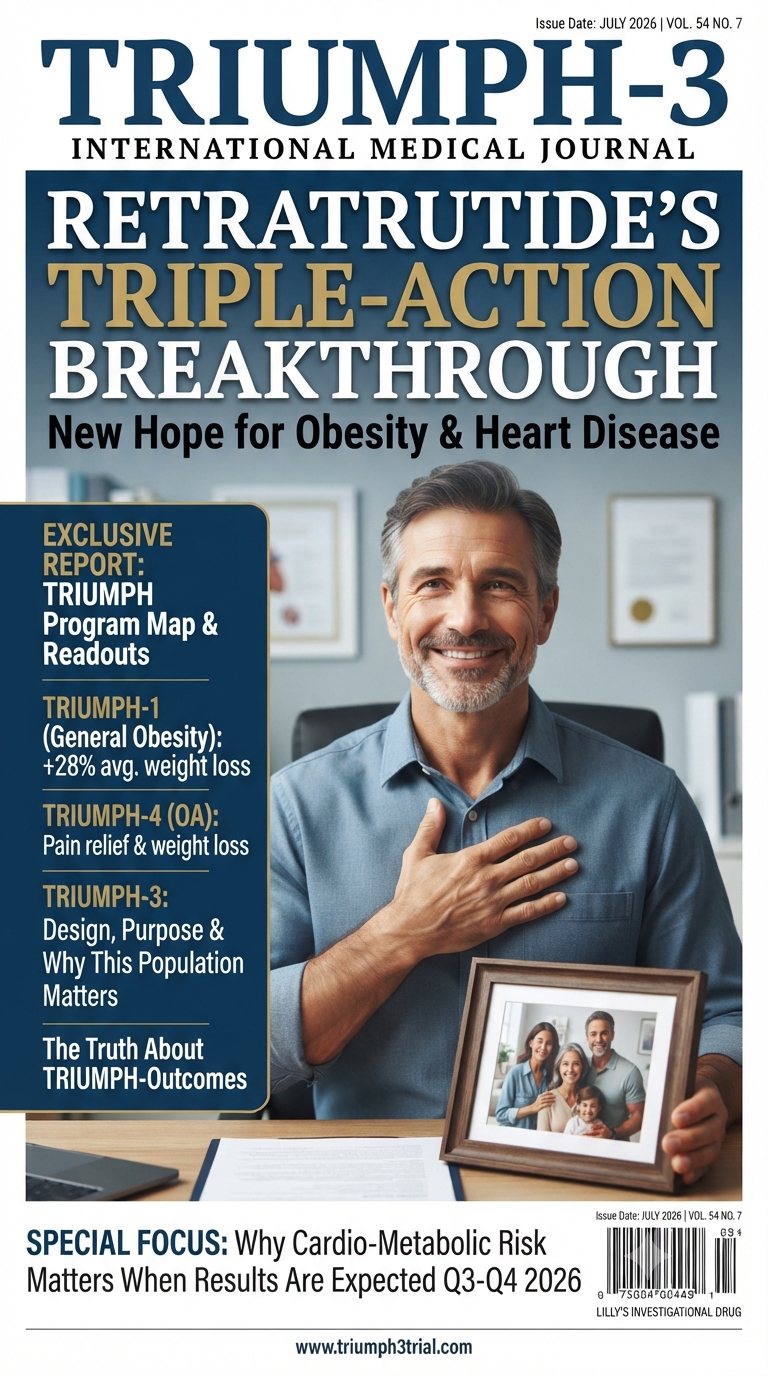
TRIUMPH-3: What We Know About Retatrutide’s Trial in Obesity and Heart Disease
Research use only: Retatrutide is an investigational compound and is not approved by the FDA for human use. Information on this page is for research and educational purposes only and does not constitute medical advice or an endorsement to purchase for personal use.
Weight loss drugs have changed a lot in the last five years. First came semaglutide. Then tirzepatide. Now Eli Lilly is testing something stronger: retatrutide, a once-weekly shot that acts on three different hormone receptors at once instead of one or two. The company calls this triple action, and early data suggests it produces the biggest average weight loss ever recorded in a large obesity drug trial.

But weight loss numbers only tell part of the story. The real question for a drug like this is whether it actually protects people who already have heart problems. That’s exactly what TRIUMPH-3 is built to answer.
This trial sits inside a much bigger research program named TRIUMPH, and it focuses on a group of patients who rarely get enough attention in obesity drug studies: people who are living with obesity and who already have diagnosed cardiovascular disease. Heart attack survivors. People with blocked arteries. Patients managing angina or a prior stroke, all while also carrying excess body weight.
Below is a detailed overview of TRIUMPH-3. It explains how the study was designed. Also shows the reasons why its participant population is so important. It also reviews what other TRIUMPH trials have already shown. Additionally, when the TRIUMPH-3 results are expected. A quick note before we start: as of this writing, TRIUMPH-3 has not yet reported results. Lilly’s own guidance puts the readout in the second half of 2026. So this article covers the trial itself in detail, design, purpose, population, mechanism, and timing, rather than results that don’t exist yet. We’ll update this once topline data lands.
What Exactly Is Retatrutide?
Before getting into TRIUMPH-3 itself, it helps to understand the drug being tested.
Retatrutide (its lab code is LY3437943) is an injectable medicine given once a week under the skin. What sets it apart from earlier obesity drugs is how many biological switches it flips at the same time. Most drugs in this class, including semaglutide (Wegovy, Ozempic) and tirzepatide (Zepbound, Mounjaro), work by activating one or two gut hormone receptors:
- GLP-1 (glucagon-like peptide-1), slows digestion, reduces appetite, and helps control blood sugar
- GIP (glucose-dependent insulinotropic polypeptide), works alongside GLP-1 to improve how the body handles food and insulin
Retatrutide adds a third target on top of those two:
- Glucagon receptor, this one is different. Instead of just curbing appetite, it appears to raise the amount of energy the body burns at rest.
That third mechanism is why some researchers describe retatrutide as working on two fronts instead of one, it turns down how much a person eats while turning up how much energy their body spends. Whether that translates into meaningfully better outcomes for heart patients specifically is the open question TRIUMPH-3 is trying to answer.
The TRIUMPH Program: A Quick Map
Instead of running one giant obesity trial and calling it a day, Lilly split its Phase 3 program into several parallel studies, each aimed at a different patient group. This approach lets the company gather evidence for multiple potential uses at roughly the same time, rather than waiting years between each one.
Here’s a simplified breakdown of the core trials in the program:
| Trial | Population | Primary Focus | Status |
|---|---|---|---|
| TRIUMPH-1 | Obesity/overweight, no diabetes | Body weight change at 80 weeks | Positive topline results, May 2026 |
| TRIUMPH-2 | Obesity/overweight with type 2 diabetes | Body weight change | Readout expected mid-to-late 2026 |
| TRIUMPH-3 | Obesity with established cardiovascular disease | Body weight change and cardiometabolic risk markers | Readout expected Q3–Q4 2026 |
| TRIUMPH-4 | Obesity with knee osteoarthritis | Body weight and joint pain (WOMAC score) | Positive topline results, December 2025 |
| TRIUMPH-Outcomes | Obesity with atherosclerotic cardiovascular disease and/or chronic kidney disease | Major cardiovascular events (MACE) and kidney outcomes over roughly 5 years | Ongoing, results likely 2028 or later |
Notice that last row. This is a point that trips a lot of people up, so it’s worth being precise about it.
TRIUMPH-3 Is Not the Same Trial as TRIUMPH-Outcomes
People often mix these two up because they both involve heart disease and both involve retatrutide. They are not the same study, and the difference matters.
TRIUMPH-3 is one of the registrational obesity trials, built the same way as TRIUMPH-1, TRIUMPH-2, and TRIUMPH-4. Its main job is to measure body weight loss and cardiometabolic risk factors in people who already have cardiovascular disease. It runs on a similar timeline to the other core trials, well under two years, and its main goal is to support an obesity drug approval in a higher-risk patient group.
TRIUMPH-Outcomes, registered on ClinicalTrials.gov as NCT06383390, is a separate and much larger study. It enrolls adults with a BMI of 27 or higher who have atherosclerotic cardiovascular disease, chronic kidney disease, or both. This trial is designed to run for about five years and will track whether retatrutide actually reduces hard cardiovascular events. For example heart attacks, strokes, cardiovascular deaths. and whether it slows kidney disease progression.
Think of it this way: TRIUMPH-3 tells you whether the drug works and is safe in people who already have heart disease. TRIUMPH-Outcomes tells you whether the drug actually prevents future heart attacks and strokes in that group. Both matter, but they answer different questions, and they report on very different timelines. TRIUMPH-3 results are expected this year. TRIUMPH-Outcomes results are years away.
Why Study Obesity Drugs Specifically in Heart Patients?
It’s a fair question. Why not just let TRIUMPH-1’s general obesity data cover everyone, cardiovascular disease or not?
There are a few solid reasons researchers separate this group out.
People with heart disease are often excluded from early trials
Standard practice in drug development is to test a new medicine in a relatively healthy population first, then slowly expand into people with more complicated health histories. Someone who’s had a heart attack, has unstable angina, or takes half a dozen medications for their heart is a different kind of patient than someone with obesity and no other major diagnosis. Testing separately in this group avoids muddying results and gives doctors clear data on what to expect.
Drug interactions and polypharmacy
Heart patients are usually on several medications already: statins, blood thinners, beta blockers, blood pressure drugs, and sometimes diabetes medications too. Adding a new drug into that mix carries more risk of interaction or side effects that wouldn’t show up as clearly in someone taking one or two medications. TRIUMPH-3 helps confirm that retatrutide behaves predictably when layered on top of standard cardiac care.
Cardiometabolic risk factors carry more weight in this group
For someone without heart disease, a drop in blood pressure or triglycerides is a nice bonus. For someone who has already had a cardiac event, those same numbers are directly tied to their risk of a second one. TRIUMPH-3 puts extra focus on measuring these markers, blood pressure, cholesterol fractions, inflammatory markers like hsCRP, and waist circumference, because in this population, they’re not just side benefits. They’re central to the whole point of the treatment.
Regulatory and labeling reasons
The FDA doesn’t just approve a drug once and call it done. Drug labels often carry specific warnings, contraindications, or usage notes tied to particular patient groups. Having dedicated data from a cardiovascular disease population gives Lilly a stronger basis to support prescribing in this group and gives doctors clearer guidance on what to expect when treating patients with both obesity and heart disease.
TRIUMPH-3 Trial Design: What We Know
Details on TRIUMPH-3’s exact protocol come from the design paper published by Giblin and colleagues in the journal Diabetes, Obesity and Metabolism in early 2026, along with Lilly’s public trial registrations. Here’s what that design looks like at a high level.
Population
TRIUMPH-3 enrolls adults with obesity or overweight who already have established cardiovascular disease. In practical terms, that generally means people with a history of things like heart attack, coronary artery disease, peripheral artery disease, or prior stroke. This is a notably different enrollment bar than TRIUMPH-1, which specifically excluded people with type 2 diabetes and focused on a broader weight-related comorbidity population like hypertension, high cholesterol, or sleep apnea.
Structure and dosing
Like its sibling trials, TRIUMPH-3 follows a randomized, double-blind, placebo-controlled design. That means participants are randomly assigned to a dose group or to placebo, and neither the participants nor the study staff know who’s getting which until the trial ends. This is the gold standard for testing whether a drug’s effects are real or just a result of chance, lifestyle changes, or expectation.
Dosing follows the same pattern used across the TRIUMPH program: a slow step-up schedule that gradually raises the dose every few weeks, moving from a low starting dose up toward a target maintenance dose. This gradual titration approach is standard for this drug class and is meant to reduce nausea and other digestive side effects that tend to be worse when a dose is increased too quickly.
Primary endpoint
The main measurement TRIUMPH-3 is built around is percent change in body weight from baseline, matching the primary endpoint used in TRIUMPH-1, TRIUMPH-2, and TRIUMPH-4. Alongside that, the trial tracks a set of cardiometabolic secondary endpoints that carry extra significance in a heart disease population, things like systolic blood pressure, non-HDL cholesterol, triglycerides, and inflammatory markers.
Duration
The core TRIUMPH obesity trials generally run somewhere between 68 and 80 weeks for their primary endpoint measurement, which is longer than many earlier obesity drug trials in this drug class. A longer trial window lets researchers see whether weight loss keeps building, levels off, or starts to reverse before the study ends, which matters a lot when judging how durable a drug’s effect really is.
What the Sibling Trials Already Suggest
Since TRIUMPH-3 hasn’t reported yet, the closest thing we have to a preview is looking at what TRIUMPH-1 and TRIUMPH-4 already showed. These aren’t the same patient population, so results won’t transfer over directly, but they give a reasonable sense of what retatrutide tends to do at the doses being tested.
TRIUMPH-1 topline numbers (general obesity, no diabetes)
Reported in May 2026, this trial enrolled just over 2,300 adults with obesity or overweight and at least one weight-related health issue. Results at the 80-week mark:
- 12 mg dose: average weight loss of 28.3%, about 70.3 pounds
- 9 mg dose: average weight loss of 25.9%, about 64.4 pounds
- 4 mg dose: average weight loss of 19.0%, about 47.2 pounds
- Nearly half of participants on the highest dose lost 30% or more of their starting body weight
- Roughly two out of three people on the 12 mg dose ended the trial with a BMI under 30, moving them out of the obesity category entirely
Just as important for a trial like TRIUMPH-3, TRIUMPH-1 also tracked cardiometabolic markers and found meaningful improvements from baseline in waist circumference, non-HDL cholesterol, triglycerides, systolic blood pressure, and hsCRP, a marker of inflammation tied to cardiovascular risk. Those are exactly the kinds of numbers that matter most for someone who’s already had a heart event.
TRIUMPH-4 topline numbers (obesity with knee osteoarthritis)
Reported in December 2025 as the first Phase 3 readout in the whole program, this trial enrolled 445 adults with obesity and painful knee osteoarthritis, again excluding people with type 2 diabetes. At 68 weeks:
- 12 mg dose: average weight loss of 28.7%
- 9 mg dose: average weight loss of 26.4%
- Placebo: average weight loss of 2.1%
The trial also showed sizable reductions in joint pain scores, with more than one in eight people on active treatment reporting no pain at all by the end of the study.
What this might mean for TRIUMPH-3
People with established cardiovascular disease tend to be older on average, often carry more medical complexity, and sometimes respond somewhat differently to metabolic drugs than a general obesity population. It’s reasonable to expect weight loss figures in TRIUMPH-3 that are in a broadly similar range to TRIUMPH-1 and TRIUMPH-4, though possibly a bit more modest given the population differences. Cardiologists will likely look beyond the weight loss percentage. They will pay close attention to the cardiometabolic data. This includes changes in blood pressure, lipid levels, and inflammatory markers.
The Mechanism Behind the Cardiometabolic Effects
It’s worth spending a moment on why a weight loss drug would move markers like blood pressure and cholesterol at all, since that’s central to why TRIUMPH-3 exists.
A lot of it comes down to simple physiology. Carrying less body weight reduces the mechanical and metabolic strain on the heart and blood vessels. Less visceral fat around the organs generally means less low-grade inflammation, better insulin sensitivity, and often improved blood pressure control, since fat tissue itself produces hormones and inflammatory signals that can push blood pressure and cholesterol in the wrong direction.
But there’s likely more going on than weight loss alone. The glucagon receptor activity in retatrutide is thought to raise resting energy expenditure, meaning the body burns more calories even without additional activity.
Some researchers believe this mechanism may directly reduce liver fat and improve lipid metabolism. They think these effects may go beyond the benefits of weight loss alone.
Phase 2 studies of retatrutide showed large reductions in liver fat. Many participants reached normal liver fat levels after 48 weeks.
Liver fat is closely linked to cardiovascular risk. Therefore, lower liver fat levels could contribute to the cardiometabolic benefits that researchers are monitoring in TRIUMPH-3.
None of this proves the drug reduces actual heart attacks or strokes. That’s a much higher bar, and it’s the exact question TRIUMPH-Outcomes is built to answer over its five-year run. TRIUMPH-3 is a step toward that answer, not the final word on it.
How TRIUMPH-3 Compares to Other Heart-Focused Obesity Research
Researchers have already tested other drugs in the same class as retatrutide in people with cardiovascular disease. The SELECT trial showed that semaglutide reduced the risk of major cardiovascular events in people with obesity and existing heart disease. The benefit also appeared in participants without diabetes.
The SELECT trial marked a turning point for obesity treatment. It showed that these medications can do more than support weight loss. It also established their potential role in improving cardiovascular health.
TRIUMPH-3 and its larger sibling, TRIUMPH-Outcomes, are part of Lilly’s attempt to build a similar case for retatrutide, and by extension for tirzepatide as well, since Lilly has been running comparable outcomes work across its GLP-1 class portfolio.
If TRIUMPH-3’s cardiometabolic secondary data lines up with what SELECT demonstrated for semaglutide, it would strengthen the argument that this whole drug class has real value for heart patients, not just for people trying to lose weight for its own sake. The eventual TRIUMPH-Outcomes trial is the one that will actually confirm or challenge that theory using hard cardiovascular endpoints, but TRIUMPH-3’s data will be an early signal worth watching closely.
Cardiometabolic secondary data refers to health information or statistics related to the heart and metabolism that has already been collected by someone else and is being reused for new research, analysis, or monitoring
TRIUMPH-3 Safety Profile: What to Expect
TRIUMPH-3 has not released its safety data yet. For now, researchers rely on the safety results from earlier retatrutide trials. Those studies showed a fairly consistent side effect profile across this drug class.
Researchers do not expect major differences in TRIUMPH-3. However, they will closely monitor participants with cardiovascular disease. Many of these participants already take multiple medications.
Common side effects reported in earlier retatrutide trials include:
- Nausea, especially during dose escalation
- Diarrhea or constipation
- Vomiting
- Decreased appetite (expected, given the mechanism)
- Injection site reactions
- A skin sensation sometimes described as dysesthesia, reported at varying rates depending on dose and trial
Discontinuation rates due to side effects have generally been modest across the program, and in some trials the lower dose arms actually showed discontinuation rates similar to or lower than placebo. Whether TRIUMPH-3’s specific population, given their additional medications and health conditions, shows a different tolerability pattern will be one of the more closely watched pieces of data when results are released.
The Regulatory Path Forward
Understanding where TRIUMPH-3 fits into Lilly’s overall approval strategy helps put the timeline in context.
Lilly already has two positive Phase 3 readouts in hand from TRIUMPH-1 and TRIUMPH-4. TRIUMPH-2 and TRIUMPH-3 are expected to report later in 2026, rounding out the core weight-management evidence package. Once enough of these trials have reported, Lilly is expected to file a New Drug Application, likely in late 2026 or early 2027. A standard FDA review typically takes ten to twelve months from filing, which points toward a possible approval sometime in late 2027 or early 2028 for the weight-management indication, assuming a standard review timeline. A Priority Review designation, if granted, could shorten that window, though that hasn’t been confirmed at this point.
It’s worth being clear that cardiovascular event reduction, meaning an actual label claim that the drug lowers heart attack or stroke risk, is a separate and much longer road. That claim depends on TRIUMPH-Outcomes, the five-year cardiovascular outcomes trial, not on TRIUMPH-3. So even after an initial obesity approval lands, doctors won’t have official cardiovascular risk-reduction labeling to point to for a while longer. TRIUMPH-3’s cardiometabolic data will still be useful in the meantime as supporting evidence, even without a formal outcomes claim attached to it.
What This Means If You Have Both Obesity and Heart Disease
If you’re someone managing obesity alongside a heart condition, here’s the practical takeaway while this trial data is still pending.
Retatrutide is not approved for any use. This information is for educational purposes only. It is not medical advice or a recommendation to use retatrutide outside of approved clinical trials.
TRIUMPH-3 is an important step in retatrutide research. The study aims to provide doctors with evidence from people who already have cardiovascular disease or cardiovascular risk. This approach offers more relevant data than relying on results from healthier study populations.
For patients currently using approved options like semaglutide or tirzepatide, the SELECT trial already offers real evidence that this broader drug class can meaningfully reduce cardiovascular risk in people with obesity and heart disease. That’s a conversation worth having directly with a cardiologist or primary care doctor, based on currently approved therapies, rather than waiting on retatrutide specifically.
Open Questions TRIUMPH-3 Still Needs to Answer
A few things remain genuinely unknown until the data is actually released:
How much weight loss holds up in an older, sicker population. Cardiovascular disease patients tend to be older on average and often carry more comorbidities than a general obesity trial population. Whether the weight loss numbers land close to TRIUMPH-1’s figures or come in lower remains to be seen.
Whether cardiometabolic markers improve enough to matter clinically. A statistically significant drop in blood pressure or triglycerides is one thing. Whether the size of that drop is large enough to meaningfully change someone’s real-world risk profile is a separate and harder judgment call that cardiologists will be looking at closely.
How tolerability holds up with heavier medication loads. Heart patients are often on multiple medications already. Whether nausea, appetite loss, or other side effects create more complications when layered on top of existing cardiac drug regimens is something only real trial data can answer.
Whether the drug is being used at doses appropriate for a higher-risk group. Some outcomes trials in cardiac populations use different titration schedules or maximum doses than trials in healthier participants, out of caution. It’s worth watching whether TRIUMPH-3’s dosing approach differs meaningfully from TRIUMPH-1’s.
A Quick Timeline of the Retatrutide Story So Far
It helps to see the whole arc of development in one place, since TRIUMPH-3 is just one chapter in a longer story.
Phase 1 trials started years ago, testing basic safety and dosing in healthy volunteers. These early studies confirmed the drug’s pharmacokinetics, meaning how it moves through the body, and helped researchers settle on a dosing range worth testing further.
Phase 2 trial (published 2023) was the first real signal that retatrutide might outperform existing options. That study showed up to 24.2% average weight loss at 48 weeks on the 12 mg dose, a number that beat every GLP-1 or GIP therapy on the market at the time. That single result is largely what pushed retatrutide into such an ambitious Phase 3 program.
TRIUMPH-4 (reported December 2025) became the first Phase 3 win, showing strong weight loss alongside meaningful joint pain relief in people with knee osteoarthritis.
TRANSCEND-T2D-1 (reported March 2026) tested retatrutide in people with type 2 diabetes, showing strong blood sugar control alongside weight loss.
TRIUMPH-1 (reported May 2026) delivered the largest and most closely watched result yet: 28.3% average weight loss at 80 weeks on the highest dose, the biggest number recorded in a large Phase 3 obesity trial to date.
TRIUMPH-2 and TRIUMPH-3 are both expected later in 2026, rounding out the picture for people with type 2 diabetes and people with established cardiovascular disease, respectively.
TRIUMPH-Outcomes continues quietly in the background, tracking real cardiovascular events over roughly five years, with results not expected until 2028 or later.
Seen this way, TRIUMPH-3 isn’t an isolated study. It’s the piece of the puzzle that speaks most directly to cardiologists, and it arrives at a moment when the rest of the program has already built a strong track record.
A Short Glossary for Readers New to This Space
Clinical trial reporting comes loaded with shorthand. Here’s a plain-language guide to terms used throughout this article.
MACE (Major Adverse Cardiovascular Events)
A combined measure that usually includes cardiovascular death, non-fatal heart attack, and non-fatal stroke. This is the gold-standard endpoint for proving a drug actually protects the heart, not just that it improves risk factors on paper.
Primary endpoint: The single main result a trial is designed to measure. Everything about sample size and trial length gets built around detecting a real difference in this one measurement.
Secondary endpoint: Additional measurements tracked alongside the primary endpoint. These add context but generally carry less regulatory weight on their own.
Titration: The gradual process of raising a drug dose over time, usually done to reduce side effects that tend to be worse with a sudden jump to a high dose.
hsCRP (high-sensitivity C-reactive protein)
A blood marker of inflammation. Elevated levels are associated with higher cardiovascular risk, which is why obesity trials in heart patients track it closely.
Non-HDL cholesterol: Total cholesterol minus the “good” HDL cholesterol. It’s considered a strong overall marker of cardiovascular risk, often more informative than LDL alone.
Double-blind, placebo-controlled: A trial design where neither participants nor researchers know who is receiving the real drug versus a placebo until the study ends. This prevents bias from creeping into how results are measured or reported.
What Cardiologists Will Likely Look For First
When the TRIUMPH-3 data is released, the first headlines will likely focus on the weight loss percentage. That is because the weight loss figure is the easiest result to compare across clinical trials. However, the full study findings will likely provide a much broader picture of the treatment’s overall effects. But cardiologists reading the fine print will likely zero in on a narrower set of numbers first.
Changes in systolic blood pressure will receive close attention. Even small reductions have been linked to a lower risk of cardiovascular disease over time. Large population studies have shown this connection.
The lipid panel results will also be important. Researchers will pay close attention to non-HDL cholesterol and triglyceride levels. Improvements in these markers are associated with better heart health.
Researchers will also look closely at hsCRP, a marker of inflammation. In recent years, hsCRP has become an important measure in cardiology. Scientists now understand that inflammation can contribute to plaque buildup in the arteries, rather than simply occurring alongside it.
Beyond the numbers themselves, expect close scrutiny of how the drug performed on top of standard cardiac medications. Did blood pressure improve on top of existing antihypertensive drugs, or did it require dose adjustments to those other medications? Did older participants experience the same level of weight loss and metabolic improvements? This question is important because older adults make up a larger share of people with cardiovascular disease than they do in general obesity trials. These practical questions tend to matter more to a treating physician than the topline weight loss figure alone.
Frequently Asked Questions About TRIUMPH-3
Has TRIUMPH-3 reported results yet?
No, not as of mid-2026. Lilly’s public guidance points to a readout in the third or fourth quarter of 2026. This article will be updated once topline data is announced.
Is TRIUMPH-3 the same as the retatrutide cardiovascular outcomes trial?
No. TRIUMPH-3 is a shorter registrational obesity trial focused on weight loss and cardiometabolic markers in people with existing heart disease. The separate cardiovascular outcomes trial, known as TRIUMPH-Outcomes, is a much larger, roughly five-year study built specifically to measure whether retatrutide reduces actual heart attacks, strokes, and cardiovascular deaths.
Who is eligible for TRIUMPH-3?
The trial enrolls adults with obesity or overweight who have established cardiovascular disease, generally meaning a documented history of conditions like heart attack, coronary artery disease, or stroke.
What doses of retatrutide are being tested in TRIUMPH-3?
Based on the published trial design, TRIUMPH-3 follows a similar dosing structure to the other core TRIUMPH trials, using a gradual step-up schedule toward target maintenance doses, compared against a placebo group.
Is retatrutide approved by the FDA?
Not yet. As of mid-2026, retatrutide remains investigational. Lilly has reported positive Phase 3 results from TRIUMPH-1 and TRIUMPH-4, with additional trials, including TRIUMPH-3, expected to report later in 2026 ahead of an anticipated regulatory filing.
Why does cardiovascular disease matter so much in obesity drug trials?
Obesity and cardiovascular disease are closely linked, and many people managing both conditions take multiple medications and carry higher overall health risk. Testing drugs specifically in this population helps confirm both safety and effectiveness in the exact group most likely to benefit from meaningful weight loss and improved cardiometabolic markers.
The Bottom Line
TRIUMPH-3 is one of the more clinically important pieces of the retatrutide story, precisely because it targets a population that carries real stakes: people whose weight and heart health are already tangled together in ways that raise their day-to-day risk. It won’t tell us whether retatrutide prevents future heart attacks outright, that job belongs to the much longer TRIUMPH-Outcomes trial, but it will tell us how the drug performs, both in terms of weight loss and cardiometabolic markers, in exactly the group of people who stand to gain the most if it works as well as earlier trials suggest.
Results are expected later this year. Until then, everything about TRIUMPH-3’s actual findings remains an open question, and any numbers you see circulating before an official Lilly announcement should be treated with real caution. Keep an eye on the second half of 2026. That’s when this story gets its next real chapter.
Disclaimer
This article reflects publicly available trial design information and previously reported results from related TRIUMPH program trials as of July 2026. Retatrutide is investigational and not approved for any use by the FDA. This content is for informational purposes only and is not medical advice. Speak with a qualified healthcare provider about any questions regarding cardiovascular disease, obesity treatment, or clinical trial participation.
Leave a Reply