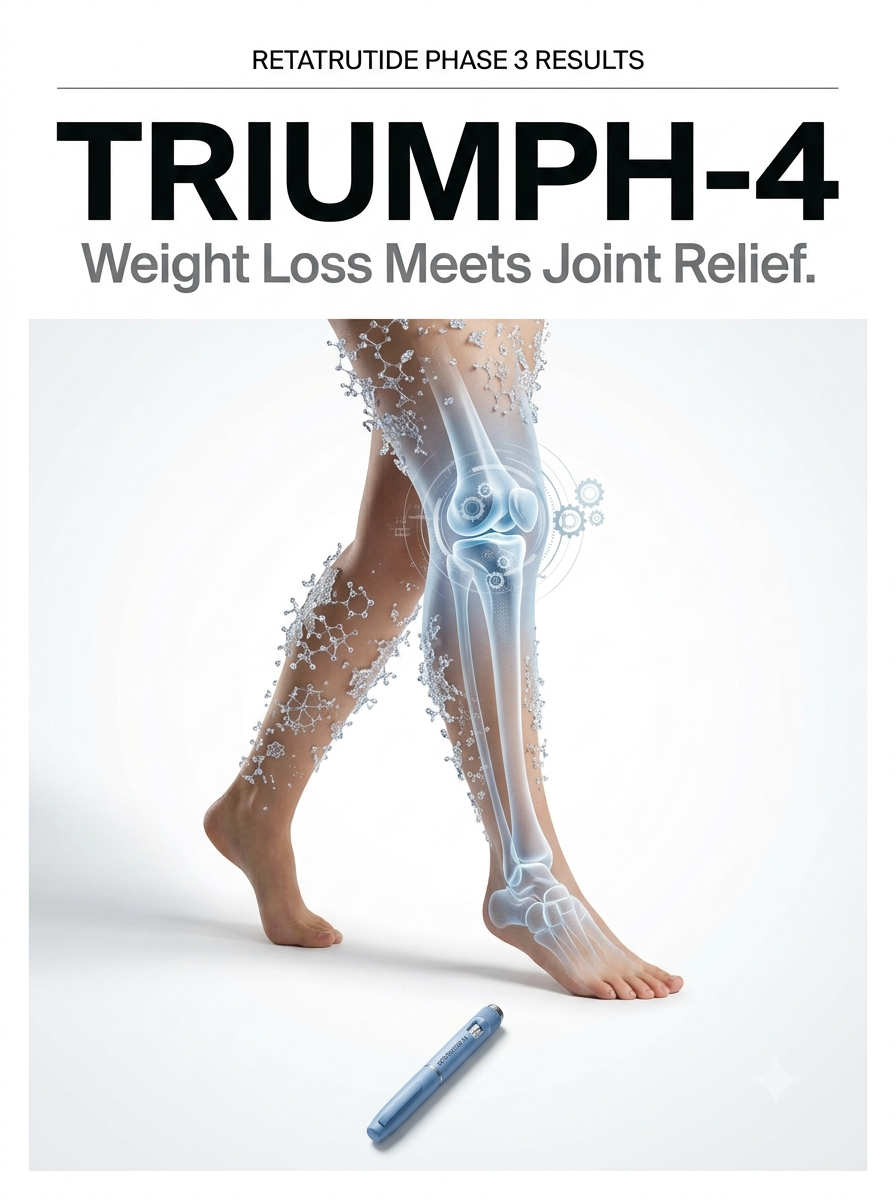
TRIUMPH-4 Retatrutide Trial: How This Triple Agonist Can Help in The Treatment of Knee Osteoarthritis Pain By Cutting Body Weight
Research use only: Retatrutide is an investigational compound and is not approved by the FDA for human use. Information on this page is for research and educational purposes only and does not constitute medical advice or an endorsement to purchase for personal use.

Abstract: TRIUMPH-4 Retatrutide Trial, was a large medical study where doctors tested a new weekly injection called retatrutide to see if it could help people lose weight and feel less joint pain at the same time. The study included 445 adults who were overweight and also had ongoing pain in their knees from worn-down cartilage, a common problem called knee osteoarthritis.
Some people got the real injection and others got a fake one, so doctors could fairly compare what happened. When the results came out in December 2025, the people who got the real injection lost close to 29% of their body weight on average, and their knee pain dropped by more than 75%, with some people ending up completely pain-free. In simple terms, this study showed that losing a large amount of weight with this new drug also brought real relief to painful joints.
Key Takeaways About TRIUMPH-4 Reta Peptide Trial
- TRIUMPH-4 was the first Phase 3 trial in Eli Lilly’s retatrutide program to report results. It was announced in December 2025, ahead of every other trial in the TRIUMPH lineup.
- The trial tested retatrutide in 445 adults with both obesity and knee osteoarthritis. By using a randomized, double-blind, placebo-controlled design over 68 weeks.
- Participants on the 12 mg dose lost an average of 28.7% of their body weight (about 71.2 lbs), while the 9 mg dose produced 26.4% weight loss, compared to just 2.1% on placebo.
- Knee pain scores dropped by up to 75.8% on the WOMAC pain scale. It nearly doubled the improvement seen in the placebo group, which also received standard lifestyle counseling.
- More than 1 in 8 participants on retatrutide were completely free of knee pain by the end of the trial, a rare outcome for a chronic joint condition.
- The trial used two co-primary endpoints (body weight and WOMAC pain score) instead of one, meaning it had to succeed on both fronts to be considered a full win — and it did.
- The weight loss and pain relief are linked through both mechanical and inflammatory pathways: losing weight reduces the physical load on the knee joint while also lowering body-wide inflammation tied to cartilage damage.
- Side effects were consistent with other drugs in this class, mainly nausea, diarrhea, constipation, and appetite loss concerns reported.
- Retatrutide is still investigational and not yet FDA-approved for any use. TRIUMPH-4’s results strengthen the case for approval but don’t guarantee a specific label for knee osteoarthritis.
- This trial set the tone for the rest of the TRIUMPH program, which has since posted even bigger weight loss numbers in TRIUMPH-1, with TRIUMPH-2 and TRIUMPH-3 still expected to report later in 2026.
Most Weight Loss Drug Trials Measure One Thing: . Triumph-4 Measured Two Things at Once
That’s what makes it different from almost every other obesity trial that came before it. This was the first Phase 3 trial in Eli Lilly’s TRIUMPH program to report results, and it landed in December 2025 with a double win. Retatrutide, the company’s experimental triple-hormone injection, didn’t just produce record-setting weight loss. It also cut knee pain scores by more than three-quarters in people with obesity and knee osteoarthritis, a condition that affects tens of millions of people and rarely gets addressed at its root cause.
Below is a full walkthrough of what TRIUMPH-4 actually found, how the trial was built, why knee osteoarthritis was chosen as a target in the first place, and what this result means for the bigger picture of obesity treatment. If you’ve read about retatrutide’s other trials, like TRIUMPH-1 or TRIUMPH-3, this one stands apart because it’s the trial that first proved the drug’s benefits reach beyond the scale and into daily physical function.
What Is Osteoarthritis?
Osteoarthritis (OA) is the most common joint disease in the world, and it’s often misunderstood as simple “wear and tear.” Modern research paints a more complete picture: OA is a disease of the whole joint, not just the cartilage. The disease develops through a tangled set of processes that includes cartilage breaking down, inflammation in the joint lining, changes in the bone just beneath the cartilage, and a general loss of balance within the joint’s internal environment. In practice, that means OA doesn’t just chip away at cartilage. It changes the bone underneath, irritates the soft tissue lining the joint, and can eventually alter the entire shape and function of the joint itself. (Source: PubMed Central)
The knees, hips, hands, spine, and feet are the joints most commonly affected, and it’s common for someone to have OA in more than one joint at the same time.
How Common Is Osteoarthritis, Really?
OA isn’t a rare or minor condition. One global estimate puts the number of people living with osteoarthritis at roughly 595 million as of 2020, close to 8% of the entire world’s population. Among adults over 70, it ranks as the seventh leading cause of years lived with disability. As the world’s population ages and obesity rates keep climbing, that burden is expected to keep growing rather than shrink. (Source: medrxiv.org)
What Actually Causes Osteoarthritis?
There’s no single cause of osteoarthritis.
Factors related to the person:
- Older age
- Female sex
- Genetics and family history
- Higher body weight
- Certain racial and ethnic backgrounds
- Lower socioeconomic status
Factors related to the joint:
- Past injury to the joint
- Repeated stress from certain jobs or sports
- Joint misalignment or unusual joint shape
- Weak muscles supporting the joint
Out of all of these, obesity and joint injury carry the strongest evidence as modifiable risk factors — meaning they’re two of the few OA risk factors a person can actually do something about. That’s a big part of why obesity treatment has become such a major focus in OA research recently. (Source: Oarsijournal)
Is knee Osteoarthritis and Osteoarthritis is The Same Disease?
knee Osteoarthritis and Osteoarthritis are the same fundamental disease, but with a different scope. Osteoarthritis (OA) is the broad, general term for the most common type of arthritis. Knee Osteoarthritis simply refers to that exact same disease when it specifically affects the knee joint.
Osteoarthritis: Also known as degenerative joint disease, this is a breakdown of the protective cartilage that caps your bones. It can affect any joint in your body, such as your hands, hips, or spine.
Knee Osteoarthritis: This is exactly the same “wear and tear” cartilage breakdown, but it is localized entirely to the knee joint. It is one of the most common places in the body for osteoarthritis to develop.
The Body-Wide Ripple Effect
OA doesn’t just stay in the joint. Research shows that about one in three people with knee osteoarthritis also experience depression. The risk is higher among women, people with obesity, and those with more severe symptoms.
Knee OA pain can last for years and often limits daily activities. Reduced mobility and the gradual loss of independence can affect a person’s emotional well-being. These challenges show that advanced knee osteoarthritis impacts more than the joint itself. Researchers increasingly view it as a condition that can affect overall quality of life, not just movement.
What Exactly Is Retatrutide?
Before digging into the trial itself, it helps to understand the drug being tested.
Retatrutide, known in research papers by its code name LY3437943, is a once-weekly injection. What makes it stand out from earlier obesity drugs is how many biological targets it hits at the same time. Most drugs in this class work on one or two gut hormone receptors:
- GLP-1 (glucagon-like peptide-1) — slows digestion and reduces appetite
- GIP (glucose-dependent insulinotropic polypeptide) — works with GLP-1 to improve blood sugar control and metabolism
Retatrutide adds a third target most drugs in this space don’t touch:
- Glucagon receptor — this one appears to raise the amount of energy the body burns at rest, not just reduce how much a person eats
That third mechanism is the reason retatrutide has posted some of the largest weight loss numbers ever recorded in a Phase 3 obesity trial. It turns down appetite while turning up energy use, a combination that seems to produce a stronger overall effect than single or dual hormone drugs.
Retatrutide is still investigational. As of mid-2026, it has not been approved by the FDA for any use, though multiple Phase 3 trials, including TRIUMPH-4, have already reported strong results.
The TRIUMPH Program: Where TRIUMPH-4 Fits
Instead of running one massive obesity trial and calling it done, Lilly split its Phase 3 program into several trials running side by side, each built around a different patient group. Here’s a simple map of the core studies:
| Trial | Population | Primary Focus | Status |
|---|---|---|---|
| TRIUMPH-1 | Obesity/overweight, no diabetes | Body weight change at 80 weeks | Positive topline results, May 2026 |
| TRIUMPH-2 | Obesity/overweight with type 2 diabetes | Body weight change | Readout expected mid-to-late 2026 |
| TRIUMPH-3 | Obesity with established cardiovascular disease | Body weight change and cardiometabolic markers | Readout expected Q3–Q4 2026 |
| TRIUMPH-4 | Obesity with knee osteoarthritis | Body weight AND knee pain (WOMAC score) | Positive topline results, December 2025 |
| TRIUMPH-Outcomes | Obesity with cardiovascular or kidney disease | Major cardiovascular events over roughly 5 years | Ongoing, results likely 2028 or later |
TRIUMPH-4 holds a special place in this lineup. It was the first of these trials to report data, which means it set the tone for the whole program. When it posted strong numbers on both weight and joint pain in December 2025, it gave Lilly, and the wider medical community, an early sign that the rest of the program was likely to deliver as well. That confidence turned out to be justified a few months later when TRIUMPH-1 posted even bigger weight loss numbers.
Why Study Obesity and Knee Osteoarthritis Together?
It might seem like an odd pairing at first. Knee pain and body weight are treated as separate problems in most doctor’s offices. But there’s solid science behind linking the two.
The mechanical connection
Every extra pound of body weight puts additional stress on the knees with each step. Orthopedic researchers often estimate that the knees experience about four times the amount of extra force compared with the weight gained.
This means losing 20 pounds could reduce knee joint pressure by roughly 80 pounds during walking. For people with damaged cartilage from osteoarthritis, this can significantly lower daily mechanical stress and wear on the joint.
The inflammation connection
Body fat isn’t just extra mass sitting on the joints. Fat tissue, especially the kind stored around the abdomen, produces inflammatory chemicals that circulate through the bloodstream and appear to make joint damage worse over time. This means obesity contributes to osteoarthritis in two separate ways: extra mechanical load and extra inflammation. A drug that reduces both body fat and systemic inflammation has a real shot at improving joint pain through more than one pathway at once.
Knee osteoarthritis is common and undertreated
Knee osteoarthritis affects a huge number of adults worldwide, and current treatment options are limited. Physical therapy, pain medication, and eventually joint replacement surgery make up most of the standard care path. None of these options address the excess body weight that’s often driving the disease in the first place. A drug that meaningfully reduces both weight and pain offers something genuinely new in this space: a non-surgical option that goes after a root cause instead of just managing symptoms.
Strategic value for the whole retatrutide program
Beyond the science, there’s a practical reason Lilly built a dedicated trial around this comorbidity. Showing clear benefit in a specific, well-defined complication of obesity, like knee osteoarthritis, strengthens the overall case for the drug and can support broader use in the real world, where most people with obesity are also managing at least one related health condition.
TRIUMPH-4 Trial Design: How It Was Built
TRIUMPH-4 is registered on ClinicalTrials.gov as NCT05931367. Details on the trial’s design come from Eli Lilly’s public announcements and the design paper published by Giblin and colleagues in the journal Diabetes, Obesity and Metabolism in 2026.
Number of Participants in TRIUMPH-4
The trial enrolled 445 adults with obesity or overweight. Participants had a BMI of 27 kg/m² or higher and a confirmed diagnosis of knee osteoarthritis. Researchers used the clinical and radiological criteria from the American College of Rheumatology to confirm OA cases.
People with type 2 diabetes were excluded from the study. This helped create a more consistent study group and allowed researchers to better measure the drug’s effects on weight loss and knee pain.
Structure and dosing fo TRIUMPH-4
TRIUMPH-4 was a randomized, double-blind, placebo-controlled study, the gold standard for testing whether a drug’s effect is real rather than a result of chance or expectation. Neither participants nor researchers knew who was receiving the real drug versus placebo until the study ended.
Participants were split 1:1:1 into three groups:
- Retatrutide 9 mg weekly
- Retatrutide 12 mg weekly
- Placebo
Dosing followed a gradual step-up schedule. Everyone started at a low 2 mg dose, which was raised every four weeks until reaching the randomly assigned target dose. That target dose was then held steady for the rest of the 68-week treatment period. This slow titration approach is standard across the retatrutide program and is designed to reduce nausea and other digestive side effects that tend to be worse when a dose is raised too quickly.
All participants, regardless of group, also received standard lifestyle counseling on diet and physical activity throughout the study. This matters because it means any results seen with the drug are on top of, not instead of, basic lifestyle guidance.
Co-primary endpoints of TRIUMPH-4
This is one of the more unusual features of TRIUMPH-4 compared to the other TRIUMPH trials. Instead of a single primary endpoint, it used two co-primary endpoints, meaning the trial had to succeed on both fronts to be considered a full success:
- Percent change in body weight from baseline to week 68
- Percent change in WOMAC pain subscale score from baseline to week 68
WOMAC stands for the Western Ontario and McMaster Universities Osteoarthritis Index. It’s the standard tool researchers use to measure osteoarthritis symptoms, covering pain, stiffness, and physical function through a validated questionnaire. Using it as a co-primary endpoint alongside body weight meant the trial was statistically built to prove the drug helps with knee pain specifically, not just weight.
Duration
The treatment period ran 68 weeks, followed by a four-week safety follow-up window. That’s a similar length to the SURMOUNT and STEP trials used for other drugs in this class, giving researchers enough time to see whether the weight loss and pain relief curves kept climbing, leveled off, or reversed before the study ended.
TRIUMPH-4 Results: The Full Breakdown
Here’s what the trial actually found, based on Eli Lilly’s topline announcement and follow-up reporting.
Weight loss results
From an average starting weight of 112.7 kg (248.5 lbs) and an average BMI of 40.4 kg/m², participants saw the following changes at 68 weeks:
- Retatrutide 12 mg: average weight loss of 28.7%, roughly 32.3 kg (71.2 lbs)
- Retatrutide 9 mg: average weight loss of 26.4%
- Placebo: average weight loss of 2.1%
Both active doses beat the Phase 2 result for the same 12 mg dose, which showed 24.2% weight loss at 48 weeks. The bigger number in TRIUMPH-4 largely reflects the longer 68-week treatment window, and it confirms something important: the weight loss curve hadn’t leveled off at 48 weeks in the earlier study. People kept losing weight with continued treatment.
Knee pain results
This is where TRIUMPH-4 really sets itself apart from every other obesity trial. WOMAC pain subscale scores dropped by:
- Retatrutide (pooled active doses): up to 4.5 points, a 75.8% reduction from baseline
- Placebo: 2.4 points, a 40.3% reduction from baseline
To put that in plain terms, people on retatrutide saw almost twice the pain relief of people on placebo, even though the placebo group also received standard lifestyle counseling. And this wasn’t a small, borderline effect. A reduction of this size is considered clinically meaningful, not just statistically significant, meaning patients could actually feel and notice the difference in daily life.
Maybe the most striking number in the whole trial: more than one out of every eight people treated with retatrutide were completely free of knee pain by the end of the study. For a chronic condition that typically only gets worse over time without surgery, that’s a remarkable outcome.
Physical function improvements
Beyond pain scores, the trial also tracked physical function using the WOMAC function subscale, which measures how easily someone can do everyday tasks like climbing stairs, getting out of a chair, or walking on a flat surface. Participants on retatrutide showed significant improvements here as well, which matters because pain relief on paper doesn’t always translate into someone actually being able to move more freely. In this case, it did. Patients reported being able to do things they hadn’t managed in years, including easier walking and stair climbing.
Cardiometabolic markers
TRIUMPH-4 did not focus on cardiovascular disease like TRIUMPH-3. However, researchers still tracked cardiometabolic risk factors as secondary measures.
The results showed improvements in blood pressure and other cardiovascular risk markers. These changes appeared alongside weight loss and reduced knee pain. The findings suggest that retatrutide may affect multiple body systems linked to obesity.
Comparing the 9 mg and 12 mg Doses
The two active doses showed different weight loss results. This difference gives researchers more insight into how retatrutide works.
The 12 mg dose produced greater weight loss than the 9 mg dose. Participants on 12 mg lost 28.7% of their body weight, while those on 9 mg lost 26.4%. This follows the dose-response pattern seen across the retatrutide program.
Higher doses generally lead to greater weight loss. However, the difference becomes smaller at higher doses. This suggests the effect may start to level off near the top of the tested range.
The pain results tell a different story. Lilly reported pain improvements as a combined result from both active doses. The company did not provide separate pain data for the 9 mg and 12 mg groups in its initial announcement.
Because of this, researchers cannot confirm whether the 12 mg dose provided better pain relief than the 9 mg dose. The two doses may have produced similar improvements in knee pain.
One possibility is that weight loss provides most of the joint relief after reaching a certain point. Additional weight loss may not create the same increase in pain improvement.
Future peer-reviewed data should provide a clearer dose-by-dose analysis of the WOMAC pain scores.
This difference matters for patients and doctors. If both doses provide similar pain relief, a lower dose may offer benefits with better tolerability. If the higher dose provides stronger pain relief, doctors may consider it for patients who need greater weight reduction.
More detailed trial data will help answer these questions when researchers publish the full results.
How Weight Loss Actually Translates Into Less Knee Pain
The biology behind these results deserves attention. The size of the pain reduction in TRIUMPH-4 has drawn interest from orthopedic researchers, not just metabolic disease specialists.
Knee cartilage has very limited ability to repair itself after damage. It has no direct blood supply, and cartilage cells work slowly compared with many other tissues. Because of this, osteoarthritis treatments usually focus on protecting the joint environment rather than rebuilding damaged cartilage.
Reducing pressure on the joint and lowering inflammation are two key strategies. Weight loss can help with both.
Every pound of weight loss reduces the force the knee absorbs during movement. Losing fat, especially around the abdomen, may also reduce inflammatory signals linked to cartilage damage.
Retatrutide causes significant weight loss, which may provide these benefits faster than traditional diet and exercise approaches alone. This could help explain why TRIUMPH-4 showed stronger improvements in knee pain compared with many previous lifestyle-based osteoarthritis studies.
Researchers also believe retatrutide may have effects beyond weight reduction. The drug may influence inflammation and metabolic pathways directly. Similar patterns appeared in earlier retatrutide studies, where reductions in liver fat seemed greater than expected from weight loss alone.
Future research will help determine how much of the joint pain improvement comes from reduced mechanical stress and how much comes from retatrutide’s possible anti-inflammatory and metabolic effects.
How the Market and Medical Community Reacted
TRIUMPH-4’s December 2025 announcement carried extra weight because it was the very first Phase 3 result from the entire retatrutide program. Until that point, everything known about the drug came from smaller, earlier-stage studies, so this readout served as the first real test of whether the strong Phase 2 numbers would hold up at a larger scale and over a longer treatment period.
The result did more than confirm the weight loss trend. It also gave the broader obesity treatment field, doctors, researchers, and investors alike, a new data point to consider: that this drug class might have real value beyond appetite control and blood sugar management, reaching into structural, mechanical conditions like joint disease that were previously treated as entirely separate medical problems. That shift in framing has continued to shape how later TRIUMPH trials, including TRIUMPH-1’s cardiometabolic secondary data and the upcoming TRIUMPH-3 results, are being discussed and anticipated.
Open Questions TRIUMPH-4 Still Leaves Unanswered
Even with a strong topline result in hand, a few things remain unclear until the full peer-reviewed dataset is available.
How long the pain relief lasts after treatment stops. TRIUMPH-4 measured outcomes during active treatment. Whether knee pain returns if someone stops taking the drug, similar to the weight regain pattern seen with other drugs in this class after discontinuation, is not yet known.
Whether the effect holds up across different severity levels of osteoarthritis. The topline results describe the study population as a whole. It’s not yet clear whether people with milder joint damage responded differently than people with more advanced disease, which could matter a great deal for how doctors decide who’s the best candidate for this kind of treatment.
How much of the benefit is mechanical versus inflammatory. As discussed above, researchers still need to work out how much of the pain relief comes from reduced load on the joint versus a more direct effect on inflammation, and that answer could shape how the drug gets positioned relative to other joint-focused treatments down the road.
Whether these results hold up in a more diverse, real-world population. Clinical trial populations are carefully screened and don’t always reflect the full range of patients a drug will eventually be prescribed to. Real-world data, once the drug is approved and used more broadly, will help confirm whether the TRIUMPH-4 results generalize outside a controlled trial setting.
Why the WOMAC Result Matters So Much
It’s worth slowing down on the pain data, because it’s easy to skim past a percentage and miss why it’s a genuinely big deal.
Knee osteoarthritis pain typically gets managed, not fixed. Standard treatment usually means over-the-counter pain relievers, physical therapy, occasional steroid injections, and eventually a joint replacement once the joint has worn down enough. None of these approaches reverse the underlying disease process. They manage symptoms while the joint continues to degrade.
A 75.8% reduction in pain scores is a major finding. More than one in eight participants also reported having no pain at all.
These results suggest that retatrutide may do more than simply manage symptoms. It could potentially influence the underlying factors that drive obesity-related joint pain.
Researchers still need to understand the exact reasons behind this effect. The improvement may come from lower pressure on the knee joint, reduced inflammation, or other effects of the drug.
Regardless of the mechanism, the size of the improvement could change how doctors approach obesity-related knee pain. For some patients, treatments like this may become an option alongside, or potentially before, surgical approaches.
The Role of Lifestyle Counseling in the Trial
One detail that’s easy to miss in the headline numbers: every participant in TRIUMPH-4, including the placebo group, received standard lifestyle counseling on diet and physical activity throughout the entire 68-week study. That’s an important design choice, because it means the placebo group wasn’t just sitting still and doing nothing. They were getting the same baseline coaching that a doctor might offer any patient managing obesity and joint pain.
This matters for interpreting the results. The 2.1% weight loss and 40.3% pain reduction seen in the placebo group already reflect some benefit from lifestyle changes alone, a reminder that diet and activity coaching does help, just not nearly as much as the drug on top of it. The gap between placebo and retatrutide, both in weight loss and pain relief, represents the added effect of the medication itself, above and beyond what counseling alone typically achieves. That’s a cleaner, more honest way to measure a drug’s true effect than comparing it to a group that received no guidance at all.
What Daily Life Might Look Like With This Kind of Improvement
Numbers on a page can be hard to translate into what they actually mean day to day. A 75.8% reduction in WOMAC pain score, paired with real weight loss, generally corresponds to things like less pain going up and down stairs, an easier time standing up after sitting for a while, and being able to walk longer distances without needing to stop and rest. For someone who has spent years modifying their daily routine around a painful knee, changes like these can affect far more than physical comfort. They can open the door back up to activities that had quietly been given up: taking a dog for a longer walk, playing with grandchildren on the floor, or simply getting through a full day of work without dreading the walk to the parking lot.
Lilly’s own summary of the trial noted that patients reported being able to do things they hadn’t done in years, a detail that speaks to how meaningful a strong WOMAC result can be beyond the statistics. This kind of functional improvement is exactly what makes co-primary endpoints like the ones used in TRIUMPH-4 so valuable. They force a trial to prove real, lived benefit, not just a favorable number on a chart.
Safety Profile: What TRIUMPH-4 Showed
Every trial in the retatrutide program has reported a broadly similar safety pattern, and TRIUMPH-4 was no exception. The most commonly reported side effects were:
- Nausea, especially during the dose escalation period
- Diarrhea
- Constipation
- Vomiting
- Decreased appetite (expected, given how the drug works)
- Injection site reactions
These are consistent with what’s been seen across other drugs in the same hormone-receptor class, including semaglutide and tirzepatide. Lilly described the safety profile as consistent with the broader incretin drug class, meaning no major new safety signals showed up in this trial that weren’t already expected based on earlier retatrutide studies.
Discontinuation due to side effects has generally stayed at a manageable level across the TRIUMPH program, and the gradual dose titration schedule appears to help keep digestive side effects tolerable for most participants. Full safety details from TRIUMPH-4, including specific discontinuation rates and any dose-specific differences, are expected to be published in a peer-reviewed journal and presented at a future medical meeting.
How TRIUMPH-4 Compares to Other Weight Loss Trials
Retatrutide’s weight loss numbers across the whole TRIUMPH program have consistently outpaced earlier trials for other drugs in the same class. For context:
- Retatrutide (TRIUMPH-4, 12 mg, 68 weeks): 28.7% weight loss
- Tirzepatide (SURMOUNT-1, highest dose, 72 weeks): roughly 22.5% weight loss
- Semaglutide (STEP-1, highest dose, 68 weeks): roughly 14.9% weight loss
These aren’t head-to-head trials, so direct comparisons come with caveats. Different trials enroll different populations and use different statistical methods. But the gap is large enough that it’s drawn significant attention from researchers and investors alike, and it’s a big part of why retatrutide is considered one of the most closely watched drugs in the entire obesity treatment space right now.
On the osteoarthritis side, there isn’t a direct equivalent trial to compare against. Tirzepatide and semaglutide haven’t run dedicated Phase 3 trials specifically measuring knee osteoarthritis outcomes using WOMAC as a co-primary endpoint, which means TRIUMPH-4 currently stands as one of the clearest pieces of evidence linking this drug class to meaningful joint pain relief, not just general improvement from carrying less body weight.
What Comes Next for Retatrutide
TRIUMPH-4 was just the opening chapter. Since its December 2025 readout, the rest of the TRIUMPH program has continued to report results:
TRANSCEND-T2D-1 (reported March 2026) tested retatrutide in people with type 2 diabetes, showing strong blood sugar control alongside weight loss.
TRIUMPH-1 (reported May 2026) delivered the largest weight loss result in the program so far: 28.3% average weight loss at 80 weeks on the highest dose, in a general obesity population without diabetes.
TRIUMPH-2, focused on obesity with type 2 diabetes, is expected to report results later in 2026.
TRIUMPH-3, focused on obesity with established cardiovascular disease, is also expected to report in the second half of 2026.
TRIUMPH-Outcomes, the large cardiovascular outcomes trial tracking real heart attacks and strokes over roughly five years, remains ongoing, with results not expected until 2028 or later.
Lilly has said detailed TRIUMPH-4 data, including the full statistical breakdown and additional secondary endpoints, will be presented at a future medical meeting and submitted for publication in a peer-reviewed journal. That fuller dataset will give researchers and doctors a much closer look at how the results held up across different subgroups, such as age, starting BMI, and osteoarthritis severity.
The Regulatory Path Forward
TRIUMPH-4’s success, combined with the strong TRIUMPH-1 result that followed it, gives Lilly two positive Phase 3 readouts to build a regulatory filing around. Once enough trials in the program have reported, Lilly is expected to file a New Drug Application, likely in late 2026 or early 2027. A standard FDA review generally takes ten to twelve months from filing, putting a possible approval for the weight-management indication somewhere around late 2027 or early 2028, assuming a standard review timeline. A Priority Review designation, if granted, could shorten that window, though this has not been confirmed.
It’s worth noting that a specific FDA-approved label claim for knee osteoarthritis, separate from a general weight-management approval, would likely require its own regulatory pathway and additional discussion with the FDA. TRIUMPH-4’s data strengthens the case for retatrutide broadly and may support doctors prescribing it off-label for patients with obesity and joint pain even before an osteoarthritis-specific label exists, but that’s ultimately a decision for regulators and prescribing physicians to work out once more data is available.
What This Means If You’re Managing Obesity and Knee Pain
If you’re someone dealing with both excess weight and knee osteoarthritis, here’s the practical takeaway while this drug moves through the rest of its approval process.
Retatrutide is not yet approved for any use. Nothing in this article should be read as medical advice or encouragement to seek out the drug outside of an approved or clinical trial setting. What TRIUMPH-4 shows is that this specific combination of health issues, obesity and knee pain, responds strongly to a treatment that addresses excess weight directly, and that the benefit reaches well beyond the number on a scale.
If you’re currently managing knee osteoarthritis and carrying excess weight, this is a good moment to have a conversation with your doctor about the connection between the two. Standard treatments for weight management already approved today, including other drugs in this same hormone-receptor class, may offer some benefit for joint pain as a secondary effect of weight loss, even without the specific co-primary endpoint data that TRIUMPH-4 collected for retatrutide.
A Quick Glossary for Readers New to This Space
WOMAC (Western Ontario and McMaster Universities Osteoarthritis Index): A standard, validated questionnaire used to measure osteoarthritis symptoms, covering pain, joint stiffness, and physical function.
Co-primary endpoint: When a trial is built around two main measurements instead of one, and both have to succeed for the trial to be considered a full win. TRIUMPH-4 used body weight and WOMAC pain score as its two co-primary endpoints.
Titration: The gradual process of raising a drug dose over time, usually done to reduce side effects that tend to be worse with a sudden jump to a high dose.
Double-blind, placebo-controlled: A trial design where neither participants nor researchers know who is getting the real drug versus a placebo until the study ends. This keeps bias out of how results get measured and reported.
Clinically meaningful: A term researchers use when a result isn’t just statistically real, but large enough that patients would actually notice and feel the difference in daily life.
Incretin class: The broader group of drugs, including GLP-1, GIP, and glucagon receptor agonists, that work by mimicking natural gut hormones involved in appetite and blood sugar control.
Key Osteoarthritis vs Arthritis Differences at a Glance
| Feature [1, 2, 3, 4, 5] | Osteoarthritis (OA) | Other Arthritis (e.g., Rheumatoid) |
|---|---|---|
| Root Cause | Mechanical breakdown and wear of joint cartilage over time. | Autoimmune diseases (body attacks itself) or infections. |
| Onset & Age | Develops slowly over years, usually later in life. | Can develop rapidly and affect adults of any age. |
| Pain Pattern | Worsens with physical activity and improves with rest. | Worse at rest or in the morning; improves with activity. |
| Joint Swelling | Usually mild, hard, and bony. | Often soft, warm, and visibly inflamed. |
| Stiffness Duration | Brief, lasting under 30 minutes in the morning. | Prolonged, often lasting more than an hour. |
| Affected Areas | Weight-bearing joints (knees, hips, spine). | Commonly symmetrical small joints (hands, wrists, feet). |
Frequently Asked Questions About TRIUMPH-4
What were the main results of TRIUMPH-4?
Retatrutide produced an average weight loss of 28.7% at the 12 mg dose over 68 weeks, along with a 75.8% reduction in WOMAC knee pain scores. More than one in eight participants on retatrutide reported being completely free of knee pain by the end of the trial.
Who was eligible for TRIUMPH-4?
The trial enrolled 445 adults with a BMI of 27 kg/m² or higher who also had a confirmed diagnosis of knee osteoarthritis based on standard clinical and radiological criteria. People with type 2 diabetes were excluded.
How long did TRIUMPH-4 run?
The treatment period lasted 68 weeks, followed by a four-week safety follow-up.
Is retatrutide approved for knee osteoarthritis?
No. Retatrutide is not yet approved by the FDA for any use as of mid-2026. TRIUMPH-4’s results support the broader case for the drug, but any specific approval, whether for general weight management or for knee osteoarthritis, still depends on further regulatory review.
How does TRIUMPH-4 compare to other retatrutide trials?
TRIUMPH-4 was the first Phase 3 trial in the program to report results, and it’s unique for using knee pain as a co-primary endpoint alongside body weight. Other trials, like TRIUMPH-1, focus purely on weight loss in a general obesity population, while TRIUMPH-3 focuses on people with established cardiovascular disease.
What side effects were reported in TRIUMPH-4?
The most common side effects were nausea, diarrhea, constipation, vomiting, and decreased appetite, consistent with other drugs in the same hormone-receptor class. Lilly described the safety profile as consistent with the broader incretin drug class.
The Bottom Line
TRIUMPH-4 did something most obesity trials never attempt: it set out to prove that weight loss could directly improve a specific, painful, and common condition, and then it delivered. A 28.7% average weight loss paired with a 75.8% drop in knee pain scores is a combination that goes well beyond what most people expect from a weight loss drug. It suggests that for people carrying both excess weight and joint pain, treating the weight itself might be one of the most effective paths toward getting their mobility and daily life back.
The rest of the TRIUMPH program has continued building on this foundation, with TRIUMPH-1 posting even bigger weight loss numbers a few months later. Full peer-reviewed data from TRIUMPH-4 is still expected, and that fuller picture will offer even more detail on how these results held up across different types of patients. For now, TRIUMPH-4 stands as strong early proof that retatrutide’s effects reach further than the scale, straight into the joints and daily movement of the people taking it.
Disclaimer
This article reflects publicly available topline results and trial design information as of July 2026. Retatrutide is investigational and not approved for any use by the FDA. This content is for informational purposes only and is not medical advice. Speak with a qualified healthcare provider about any questions regarding obesity treatment, knee osteoarthritis, or clinical trial participation.
Leave a Reply