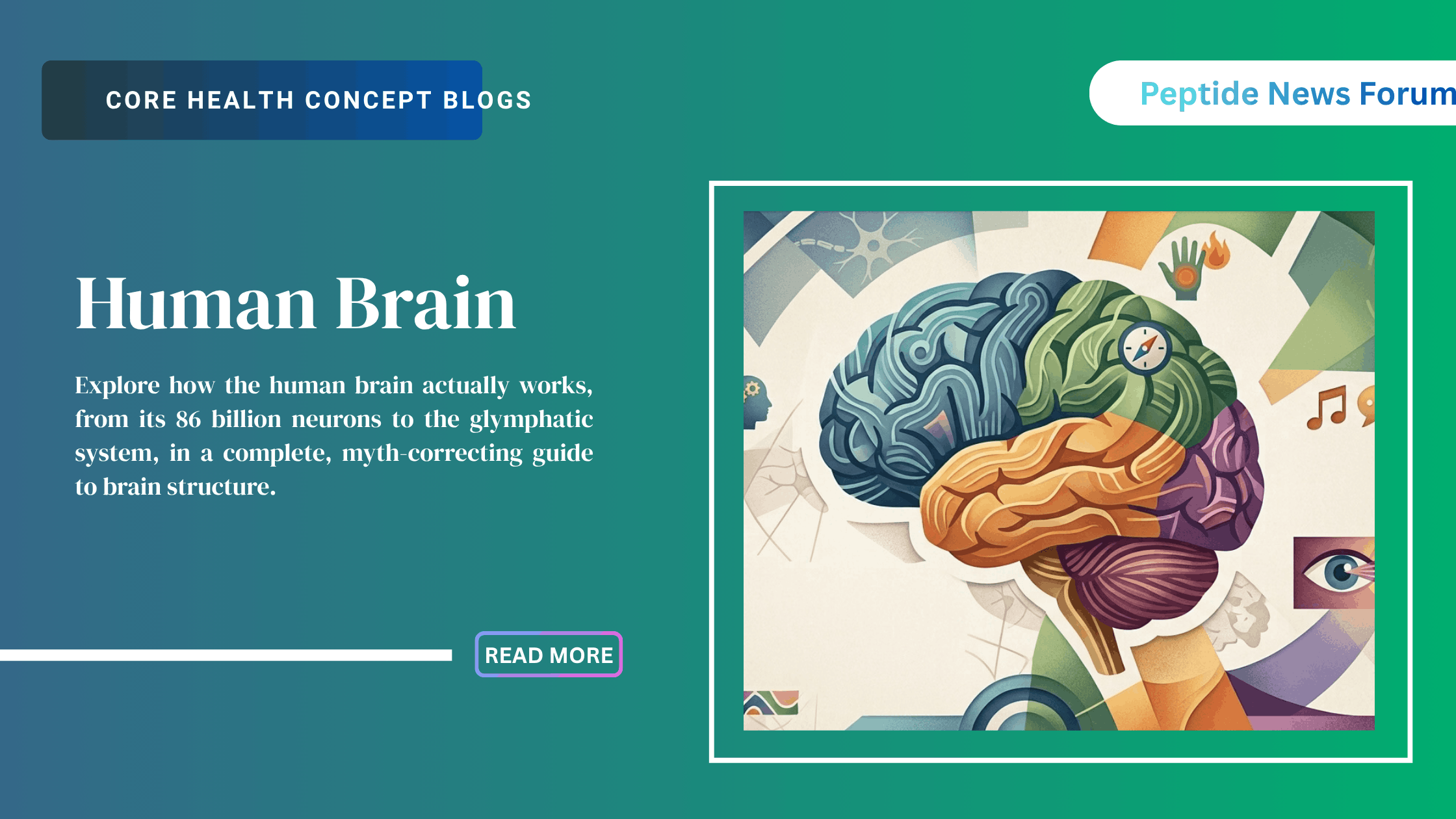
The Human Brain: A Complete Guide to Structure, Function, and Science
The brain runs every thought, movement, and heartbeat you’ll ever have, yet most people could not accurately describe what it actually looks like inside their own skull. This guide covers the brain as a whole organ: its structure, its protective layers, how its cells talk to each other, how it develops and ages, and what current research actually shows, not the recycled trivia that shows up on most brain articles.
Key Takeaways
- The human brain contains about 86 billion neurons, correcting the commonly repeated but inaccurate “100 billion” figure.
- The brain is protected by the skull, three meningeal layers, and circulating cerebrospinal fluid.
- Major brain regions, including the cerebrum’s four lobes, the cerebellum, the brainstem, and the limbic system, each handle distinct functions.
- Neurons communicate using a combination of electrical signals and chemical neurotransmitters released across synapses.
- The blood-brain barrier tightly regulates which substances can reach brain tissue.
- The glymphatic system, discovered in 2012, clears metabolic waste from the brain primarily during sleep.
- Neuroplasticity allows the brain to keep forming new connections throughout life, not just during childhood.
The brain is the central organ of the nervous system, housed inside the skull and protected by three membrane layers and a cushion of fluid. It contains about 86 billion neurons, not the commonly repeated figure of 100 billion. It uses roughly 20 percent of your body’s total energy despite weighing only about 2 percent of your total body weight. The brain divides into major regions, each handling different functions, and it stays chemically and physically connected to nearly every hormone system covered elsewhere in this guide.
What Is the Brain, Exactly?
The brain is the command organ of the central nervous system. Along with the spinal cord, it forms the body’s main processing and relay network. Every voluntary movement, every automatic function like breathing, and every conscious thought passes through this organ in some form.
Unlike most organs, the brain doesn’t work alone on a single job. It coordinates movement, stores memory, regulates emotion, manages hormone release, and keeps your heart beating, all at the same time, often without you noticing any of it happening.
The Actual Numbers: Correcting a Common Myth
Most articles about the brain repeat a figure that isn’t accurate. For decades, writers claimed the human brain contains 100 billion neurons. Nobody could ever trace that number back to an actual study.
In the mid-2000s, Brazilian neuroscientist Suzana Herculano-Houzel developed a new counting method. She dissolved donated human brain tissue into a uniform liquid suspension and counted neuron nuclei directly, rather than estimating from small tissue samples the way earlier researchers had. Her result: the human brain contains an average of 86 billion neurons, not 100 billion. Roughly 16 billion of those sit in the cerebral cortex, the wrinkled outer layer responsible for much of human thought and reasoning.
A few other numbers worth knowing:
- The adult brain weighs about three pounds, roughly 2 percent of total body weight.
- Despite that small weight, the brain consumes about 20 percent of your body’s total energy supply, mostly in the form of glucose.
- The brain contains roughly the same number of non-neuronal support cells, called glial cells, as it does neurons.
Brain Protection: Skull, Meninges, and Cerebrospinal Fluid
Your brain sits inside a genuinely well-engineered protection system, built in layers.
The skull forms the outermost, hardest barrier. Beneath it sit three thin membrane layers called the meninges: the dura mater (tough and outermost), the arachnoid mater (a web-like middle layer), and the pia mater (a thin layer that clings directly to brain tissue).
Between these membrane layers, cerebrospinal fluid (CSF) circulates continuously. This clear fluid cushions the brain against sudden impacts, removes waste products, and helps maintain stable pressure around brain tissue. An adult produces roughly half a liter of CSF per day, constantly replacing the fluid surrounding the brain and spinal cord.
The Brain’s Major Regions and What They Do
The brain divides into several major structures, each specializing in different functions. Here’s a region-by-region breakdown.
The Cerebrum and Its Four Lobes

The cerebrum makes up the largest portion of the brain, split into left and right hemispheres and further divided into four lobes on each side.
- Frontal lobe: Handles decision-making, planning, personality, and voluntary movement. This region matures last, often not fully developing until the mid-20s.
- Parietal lobe: Processes sensory information, including touch, temperature, and spatial awareness.
- Temporal lobe: Handles hearing, language comprehension, and plays a major role in memory formation.
- Occipital lobe: Processes visual information almost exclusively.
The Cerebellum
Sitting beneath the cerebrum at the back of the skull, the cerebellum coordinates balance, posture, and fine motor movement. Despite making up only about 10 percent of total brain volume, it contains more than half of the brain’s total neurons, packed into a densely folded structure.
The Brainstem
The brainstem connects the brain to the spinal cord and controls many of the functions you never consciously think about: breathing, heart rate, blood pressure, and swallowing. Damage here tends to be more immediately life-threatening than damage elsewhere in the brain, exactly because it controls these basic survival functions.
The Limbic System
This isn’t one single structure but a connected network, including the amygdala (which processes fear and emotional reactions) and the hippocampus (central to forming new long-term memories). People with hippocampus damage can often remember events from years ago while struggling to form any new memories at all, a pattern that helped researchers map this region’s specific role.
The Hypothalamus and Pituitary Gland
As covered in dedicated detail elsewhere in this series, the hypothalamus acts as the brain’s main link to the body’s hormone systems, while the pituitary gland, sitting just below it, carries out many of those hormone instructions. Nearly every hormone-related topic in this guide, from GnRH to ghrelin to the stress response, traces back to this small region.

How Brain Cells Actually Communicate?
Brain cells are called neuron or neuron cells, a neuron has three main parts. Dendrites receive signals from other neurons. The cell body processes that information. The axon carries the resulting signal onward to the next cell in line.

When a neuron fires, it doesn’t physically touch the next neuron. A tiny gap called a synapse separates them. To cross that gap, the neuron releases chemical messengers called neurotransmitters, which bind to receptors on the next cell and trigger a new signal there. This same basic process, repeated billions of times per second, produces everything from a simple reflex to a complex thought.
Meet the Major Neurotransmitters
Several neurotransmitters do most of the heavy lifting throughout the brain:
- Dopamine drives motivation, reward, and motor control. Parkinson’s disease involves the loss of dopamine-producing neurons, which is why dopamine-related medications are central to its treatment.
- Serotonin influences mood, sleep, and appetite regulation.
- GABA acts as the brain’s primary calming signal, reducing neuron activity.
- Glutamate works opposite to GABA, acting as the brain’s main excitatory signal.
- Acetylcholine supports memory, learning, and muscle activation.
- Norepinephrine drives alertness and the body’s fight-or-flight response.
- Endorphins are naturally occurring opioid peptides that reduce pain perception and contribute to feelings of wellbeing, connecting directly to the broader peptide classification covered elsewhere in this series.
The Blood-Brain Barrier: Your Brain’s Chemical Bouncer
The blood-brain barrier is a tightly regulated layer of cells lining the brain’s blood vessels. It controls which substances can pass from your bloodstream into brain tissue, blocking most bacteria, many drugs, and large molecules while still allowing oxygen, glucose, and certain small, specifically transportable molecules through.
This barrier explains a lot about peptide-based drugs covered elsewhere in this series. Many peptides simply can’t cross it effectively, which limits their direct brain effects unless specifically engineered to do so, or unless they act on structures like the hypothalamus that sit partially outside the barrier’s full protection.
Brain Energy Needs: Why This Organ Burns So Much Fuel?
The brain’s 20-percent share of your body’s total energy use is a genuinely striking number for an organ that small. Most of that energy goes toward maintaining the electrical charge across neuron membranes, the baseline condition that allows a neuron to fire quickly when needed.
This high energy demand is also why blood sugar fluctuations can affect concentration and mood so noticeably, and why prolonged oxygen or glucose deprivation damages brain tissue faster than almost any other organ in the body.
The Glymphatic System: Your Brain’s Nightly Cleanup Crew
This is one of the more significant neuroscience discoveries of the past two decades, and it rarely gets the attention it deserves in general brain content.
In 2012, neuroscientist Maiken Nedergaard and her team at the University of Rochester discovered a previously unknown waste-clearance network inside the brain. They named it the glymphatic system, combining “glial” (the support cells driving the process) with “lymphatic” (referencing the body’s waste-clearing lymph system).
The glymphatic system clears metabolic waste, including a protein called beta-amyloid linked to Alzheimer’s disease, by flushing cerebrospinal fluid through brain tissue. Here’s the genuinely important part: this system runs roughly ten times more actively during sleep than during wakefulness. Research has also found that the common sleep medication zolpidem, sold as Ambien, appears to suppress this natural cleaning process in animal studies, an interesting wrinkle given how often that drug gets prescribed specifically to help people sleep.
Neuroplasticity: The Brain Changes Throughout Life
For much of the 20th century, scientists believed the adult brain was essentially fixed, incapable of forming significant new connections past childhood. That view has been thoroughly overturned.
Neuroplasticity describes the brain’s ability to reorganize itself by forming new neural connections throughout life. Learning a new skill, recovering from a stroke, or adapting after an injury all rely on this capacity. The brain strengthens frequently used connections and gradually prunes away ones that go unused, a dynamic process that continues well into old age, not just during childhood development.
Brain Development Across the Lifespan
The brain doesn’t develop at a steady, even pace.
- Before birth, neurons form at an extraordinary rate, with the basic structural blueprint largely established by birth, even though the brain continues growing substantially afterward.
- During childhood, synaptic connections form rapidly, followed by a pruning process that eliminates unused connections, essentially refining the brain’s wiring based on actual experience.
- During adolescence, the frontal lobe, responsible for planning and impulse control, continues maturing, often not finishing until the mid-20s. This is part of why adolescent decision-making research consistently shows differences from adult patterns.
- In adulthood, brain structure stays relatively stable, though neuroplasticity continues allowing for new learning and adaptation.
With aging, some gradual volume loss and processing speed changes are considered a normal part of aging, distinct from the more significant decline seen in neurodegenerative conditions.
When the Brain Is Injured or Diseased
A few major categories of brain conditions are worth understanding at a basic level:
| Condition | What’s Happening |
|---|---|
| Stroke | Blood flow to part of the brain is interrupted, causing tissue damage |
| Traumatic brain injury | Physical impact damages brain tissue or disrupts normal function |
| Alzheimer’s disease | Progressive buildup of abnormal proteins, including beta-amyloid, disrupts neuron function |
| Parkinson’s disease | Loss of dopamine-producing neurons affects movement control |
| Epilepsy | Abnormal, excessive electrical activity causes recurring seizures |
Each of these conditions affects the brain through a genuinely different mechanism, which is exactly why treatment approaches vary so significantly between them, rather than a single universal “brain treatment” applying across the board.
How to Support Brain Health
A few habits have real, evidence-based support for brain health:
- Prioritizing sleep, given the glymphatic system’s dependence on it for clearing metabolic waste
- Regular physical activity, linked to improved blood flow and support for neuroplasticity
- A balanced diet, since stable blood sugar and adequate nutrients support the brain’s high energy demands
- Ongoing cognitive engagement, such as learning new skills, which appears to support neuroplasticity throughout life
- Managing chronic stress, since prolonged activation of the brain’s stress response has been linked to changes in memory-related brain structures over time
Frequently Asked Questions
Is it true we only use 10 percent of our brains?
No, this is a persistent myth. Brain imaging shows activity across virtually the entire brain over the course of a day, even though not every region is maximally active at the exact same moment.
Why does the brain need so much energy?
Maintaining the electrical charge across billions of neuron membranes, the baseline state that allows rapid firing when needed, requires a constant, substantial energy supply, mostly in the form of glucose.
Can the brain really heal itself after injury?
To a meaningful degree, yes, through neuroplasticity. The brain can often reorganize function around damaged areas, though the extent of recovery depends heavily on the injury’s location, severity, and the rehabilitation process that follows.
What’s the difference between the brain and the central nervous system?
The brain is one component of the central nervous system. The spinal cord is the other, serving as the main relay pathway between the brain and the rest of the body.
Does the glymphatic system explain why poor sleep affects memory and mood?
It’s one significant factor. Since this waste-clearance system depends heavily on sleep to function properly, chronic sleep disruption may allow metabolic waste to accumulate, which researchers are actively studying in connection to both cognitive function and long-term neurological health.
Leave a Reply