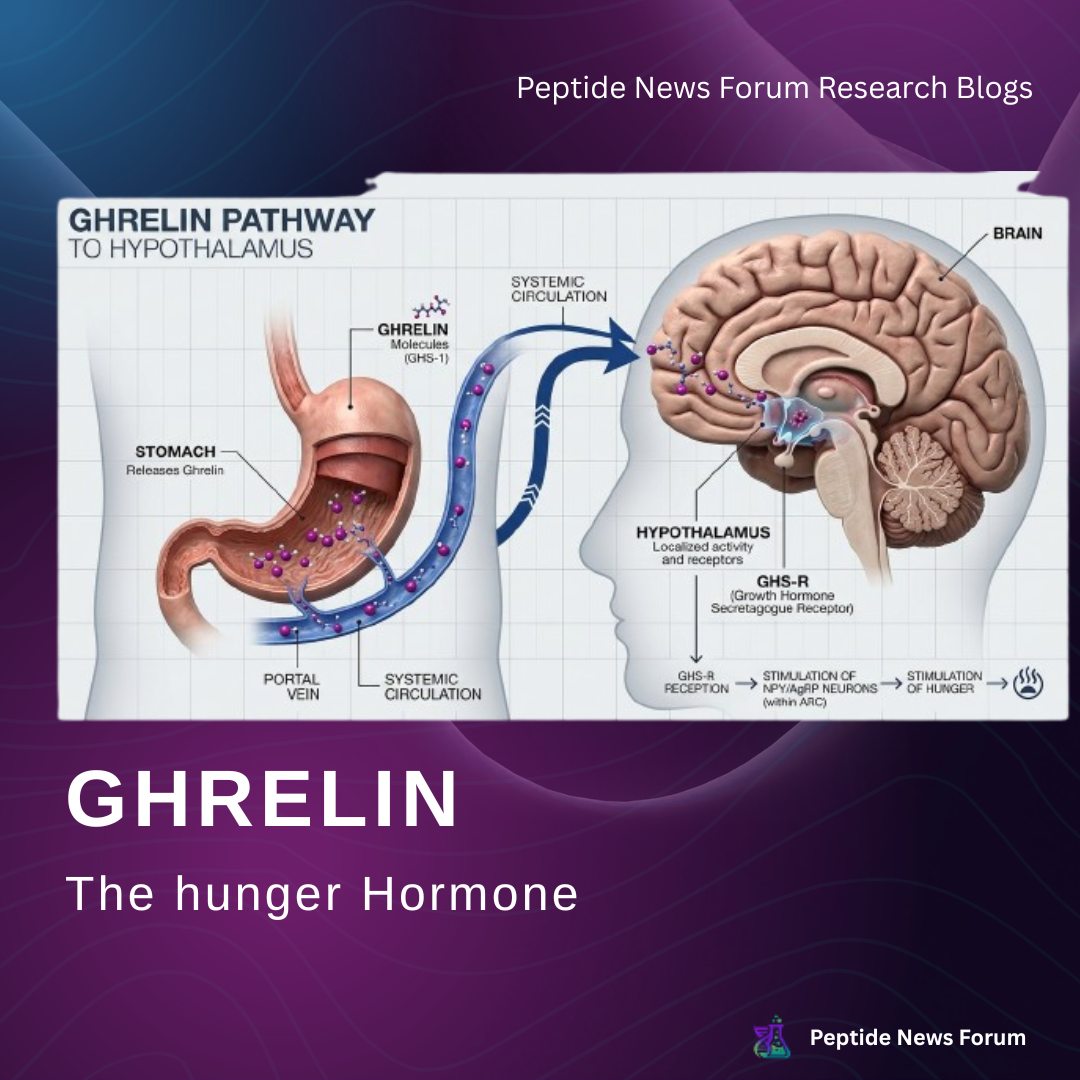
An empty stomach needs to tell your brain it is time to eat. It does this by releasing a hormone called ghrelin. Many people call it the “hunger hormone.” High ghrelin levels send constant hunger signals to your brain. This often leads to overeating and weight gain. Low ghrelin levels do the opposite. They lower your appetite and make it hard to eat enough food.
Key Takeaways
- Ghrelin is a hormone made mainly in the stomach that signals hunger to the brain, rising before meals and falling after eating.
- It was first identified in 1999 and works by activating a receptor called GHS-R1a, but only after being chemically “switched on” through a process called acylation.
- Beyond hunger, ghrelin affects growth hormone release, blood sugar regulation, gastric motility, sleep, mood, and reward pathways.
- People with obesity tend to have lower ghrelin levels, not higher, though they may be more sensitive to its effects, an area still being researched.
- Dieting, poor sleep, and stress raise ghrelin, while protein-rich eating, higher muscle mass, and bariatric surgery are linked to lower levels.
- The only FDA-approved ghrelin-related medication, macimorelin, is used for diagnosing growth hormone deficiency, not for weight or appetite treatment.
- No FDA-approved drug currently targets ghrelin directly for weight loss in healthy adults.
Your stomach doesn’t just digest food. It also talks to your brain, and one of its main messages comes from a hormone called ghrelin. Nicknamed the “hunger hormone,” ghrelin is the reason you feel that unmistakable pang before lunchtime, and it does far more behind the scenes than most people realize.
This guide covers what ghrelin actually is, how it works, what raises and lowers it, and what current research does and doesn’t support, including which ghrelin-related medications are actually FDA-approved.
At a Glance
Ghrelin is a hormone made mainly in your stomach that signals hunger to your brain. Levels rise before meals and fall after eating. Beyond appetite, ghrelin affects growth hormone release, blood sugar, sleep, mood, and heart health. Interestingly, research shows people with obesity tend to have lower circulating ghrelin, not higher, which has reshaped how scientists think about its role in weight management.
What Is Ghrelin?
Ghrelin (pronounced “GREL-in”) is a hormone produced mainly by your stomach, with smaller amounts made in your small intestine, pancreas, and brain. It’s often called the “hunger hormone” because its primary, best-known job is telling your brain it’s time to eat.
Ghrelin is a peptide, meaning it’s built from a short chain of amino acids, the same basic building blocks used throughout the body’s hormone and protein systems. It travels through your bloodstream to your brain, specifically to a region called the hypothalamus, where it triggers the sensation of hunger.
Ghrelin levels naturally rise between meals, peak right before you eat, and then drop once your stomach is full. This rhythm happens every day, largely independent of what the clock says, which is part of why hunger can strike at a “usual” mealtime even if you’re not truly low on energy.

How Was Ghrelin Discovered?
Ghrelin has a fairly short scientific history compared to hormones like insulin. Researchers first identified its receptor, called the growth hormone secretagogue receptor (GHS-R), in 1996, before anyone knew what naturally activated it.
Three years later, in 1999, a team of Japanese researchers led by Masayasu Kojima identified the actual hormone that binds to this receptor. They isolated it from rat stomach tissue and named it “ghrelin,” a name built from a root word meaning “to grow,” since the hormone triggers the release of growth hormone from the pituitary gland. That original study was published in the journal Nature and remains one of the most cited papers in the field of appetite research.
Since that discovery, ghrelin has gone from an obscure stomach hormone to one of the most studied signals in metabolic science, with thousands of follow-up studies examining its role in hunger, weight, sleep, and disease.
Where Does Ghrelin Come From?
Most of your body’s ghrelin comes from specialized cells in the lining of your stomach, particularly in the upper portion called the fundus. These cells are sometimes called P/D1 cells in humans.

Smaller amounts of ghrelin are also produced in:
- The small intestine, especially the duodenum
- The pancreas
- The brain (in specific regions involved in appetite regulation)
- The kidneys, placenta, and reproductive organs, in smaller and more specialized roles
Because the stomach is by far the largest source, procedures that reduce stomach size, like certain weight-loss surgeries, have a measurable effect on ghrelin levels. We’ll cover that in more detail later.
How Does Ghrelin Actually Work in the Body?
Understanding ghrelin’s biochemistry helps explain why it behaves the way it does.
Your body first produces a larger precursor molecule called preproghrelin. This gets trimmed down in steps, first to proghrelin, then to the active 28-amino acid hormone you’d recognize as ghrelin.
Here’s the interesting part: ghrelin isn’t fully “switched on” until an enzyme called ghrelin O-acyltransferase (GOAT) attaches a small fatty acid chain to it, a process called acylation. Only this acylated, or “acyl,” form of ghrelin can bind to its receptor and produce the classic hunger-signaling effect.
There’s also a second, unacylated version called desacyl ghrelin. It doesn’t activate the main ghrelin receptor, but researchers have found it still plays separate roles, including effects on heart function and glucose regulation, that are somewhat distinct from acyl ghrelin’s effects.
Once activated, ghrelin binds to a receptor called GHS-R1a, found in high concentrations in the hypothalamus, the pituitary gland, and along the vagus nerve, which is a major communication line between your gut and brain.
Ghrelin’s Main Job: Signaling Hunger
Ghrelin’s most well-established role is straightforward: it tells your brain you’re hungry.
When your stomach is empty, ghrelin levels climb. This hormone travels to the hypothalamus’s arcuate nucleus, where it activates specific hunger-promoting neurons, including ones that produce neuropeptide Y (NPY) and agouti-related protein (AgRP). These neurons are some of the most powerful “eat now” signals in the entire brain.
Once you eat, ghrelin levels drop within a fairly short window, and that hunger signal fades. Research has also found something interesting: ghrelin doesn’t seem to make you eat bigger meals. Instead, it appears to influence how often you feel like eating, nudging you toward more frequent meals rather than larger ones.
Beyond Hunger: Ghrelin’s Other Roles in the Body
While hunger gets all the attention, ghrelin’s job description is much longer. Here’s a breakdown of its other documented effects:
| System Affected | What Ghrelin Does |
|---|---|
| Pituitary gland | Triggers release of growth hormone |
| Pancreas | Helps regulate insulin and glucagon release |
| Digestive system | Speeds up gastric emptying and stimulates stomach acid |
| Cardiovascular system | Shows anti-inflammatory and protective effects on heart tissue in research |
| Sleep-wake cycle | Participates in regulating circadian rhythm |
| Mood and stress | Interacts with the body’s stress-response (HPA) axis |
| Reward pathways | Activates dopamine-related brain circuits tied to food and other rewards |
| Memory and learning | Influences activity in memory-related brain regions |
| Immune function | Involved in regulating inflammatory signaling molecules |
| Fetal development | Supports early lung development in the womb |
Some of these roles are backed by solid human research, like ghrelin’s effect on growth hormone release. Others, particularly around cardiovascular protection, memory, and immune regulation, are supported mainly by animal studies or early-stage human research, and scientists are still working out exactly how significant these effects are in everyday human health.
Ghrelin and Body Weight: A More Complicated Story Than You’d Expect
Given ghrelin’s nickname, you might assume people carrying more body fat simply have more of it circulating in their blood, and that’s driving their hunger. The actual research tells a more surprising story.
Multiple studies have found that people with obesity tend to have lower circulating ghrelin levels than leaner individuals, not higher. This seemed backwards at first, so researchers proposed an alternative explanation: people with obesity may be more sensitive to ghrelin’s effects, meaning even smaller amounts trigger a stronger hunger response. Some research also points to overactive ghrelin receptors as part of this picture. This is an active area of research, and scientists haven’t fully settled on why this sensitivity difference exists.
There’s a separate, well-documented pattern that trips up a lot of dieters: when you restrict calories to lose weight, your ghrelin levels rise, sometimes significantly, as your body tries to nudge you back toward eating more. This is part of why maintaining weight loss is often harder than losing the weight in the first place, a phenomenon sometimes called the weight-loss plateau. Small studies have tracked this rise over weeks and months of dieting, showing ghrelin levels can climb meaningfully as a diet continues, though individual results vary and larger studies would strengthen these findings.
What Raises Ghrelin Levels?
Several factors are linked to higher ghrelin levels:
- An empty stomach. This is ghrelin’s natural, expected trigger.
- Calorie restriction or dieting. The longer and more aggressive the restriction, generally the bigger the ghrelin increase.
- Poor sleep. Sleep deprivation is consistently linked to higher ghrelin and increased hunger the next day.
- Chronic stress. Ghrelin interacts with the body’s stress-response system, and elevated stress has been associated with higher levels in some studies.
- Certain medical conditions, including anorexia nervosa, cancer-related cachexia (severe muscle wasting), celiac disease, inflammatory bowel disease, and Prader-Willi syndrome.
- Aging. Some research suggests ghrelin levels tend to rise somewhat as people get older, though this relationship isn’t as clearly defined as the diet-related changes.
What Lowers Ghrelin Levels?
On the flip side, these factors are linked to lower ghrelin:
- Eating, especially protein and complex carbohydrates. These appear to suppress ghrelin more effectively than fatty foods.
- Higher muscle mass. People with more lean body mass tend to show lower ghrelin levels.
- Obesity, somewhat counterintuitively, as discussed above.
- Gastric bypass and sleeve gastrectomy surgery. These procedures are linked to significant, lasting drops in ghrelin, sometimes by roughly 60% after sleeve gastrectomy specifically.
- Certain gastrointestinal conditions, including chronic gastritis, H. pylori infection, functional dyspepsia, and irritable bowel syndrome.
Ghrelin and Weight-Loss Surgery
Bariatric surgery offers one of the clearest real-world examples of how directly ghrelin ties to the stomach itself.
Because most of the body’s ghrelin comes from stomach tissue, surgeries that remove or bypass large portions of the stomach, like sleeve gastrectomy or gastric bypass, tend to significantly lower ghrelin levels. Researchers believe this drop in ghrelin may partly explain why many patients report reduced hunger after these procedures, beyond just the physically smaller stomach capacity.
That said, this research area still has open questions. Scientists haven’t fully confirmed whether ghrelin levels stay permanently lower after surgery or gradually shift back over time once weight loss stabilizes. It’s also worth noting that surgery affects many hormones simultaneously, not just ghrelin, so isolating ghrelin’s exact contribution to post-surgery appetite changes is genuinely difficult.
Medical Conditions Linked to Ghrelin
Ghrelin levels can shift, sometimes dramatically, in certain health conditions. Here’s a breakdown:
| Condition | Ghrelin Pattern | Notes |
|---|---|---|
| Prader-Willi syndrome | Notably elevated | Believed to contribute to the intense, persistent hunger seen in this genetic condition |
| Anorexia nervosa | Elevated | Likely a compensatory response to severe caloric restriction |
| Cancer-related cachexia | Elevated | Despite high levels, the body’s response is often blunted, contributing to ongoing weight loss |
| Chronic gastritis / H. pylori infection | Reduced | Linked to impaired stomach lining function |
| Functional dyspepsia | Reduced | Associated with digestive discomfort and reduced appetite signals |
| Irritable bowel syndrome (IBS) | Reduced | Exact mechanism still under study |
| Celiac disease | Elevated | May relate to intestinal inflammation and nutrient malabsorption |
| Obesity | Reduced (with possible increased sensitivity) | An active and evolving area of research |
If you have persistent, unusual, or extreme hunger that doesn’t match your normal patterns, that’s worth discussing with a healthcare provider. It’s not a specific “ghrelin symptom” on its own, but it could point to an underlying condition worth investigating.
Ghrelin-Based and Ghrelin-Related Medications: What’s Actually FDA-Approved
This is where ghrelin connects directly to the broader peptide and drug-approval landscape covered elsewhere on this site, and it’s worth being precise here, since marketing claims in this space often blur real regulatory status.
Macimorelin (brand name Macrilen) is the clearest example of an FDA-approved, ghrelin-related medication. It’s an orally available ghrelin receptor agonist, approved by the FDA in December 2017. Importantly, it’s not approved as a weight or appetite treatment. It’s approved specifically as a diagnostic tool, used to help doctors test for adult growth hormone deficiency by measuring how the body responds after a dose.
Anamorelin is a ghrelin receptor agonist developed for cancer-related cachexia, and it has real clinical trial data behind it, including Phase 3 results showing improvements in appetite and lean body mass in cancer patients. However, anamorelin is approved in Japan (since January 2021, for cachexia linked to certain cancers), not in the United States. As of now, there is no FDA-approved treatment specifically for cancer cachexia using this mechanism.
Other ghrelin mimetics, like ibutamoren (also known as MK-677), are not FDA-approved for any use. These are sometimes sold online as “research chemicals,” a pattern that should sound familiar if you’ve read about other unapproved peptides on this site. The same cautions apply: no established human safety profile at these doses, no manufacturing oversight, and no legitimate approved use for personal, non-research purposes.
| Compound | FDA Status | Actual Approved Use |
|---|---|---|
| Macimorelin (Macrilen) | FDA-approved (2017) | Diagnostic test for adult growth hormone deficiency |
| Anamorelin | Not FDA-approved | Approved in Japan only, for cancer-related cachexia |
| Ibutamoren (MK-677) | Not FDA-approved | Sold as a research chemical; no approved medical use |
There is currently no FDA-approved drug that directly targets ghrelin for weight loss or appetite suppression in otherwise healthy adults.
Can You Get Your Ghrelin Levels Tested?
Technically, yes, ghrelin can be measured through blood tests used in research settings. However, this isn’t a routine part of standard medical care. Doctors don’t typically order ghrelin testing when evaluating weight management or appetite concerns, because it doesn’t currently change clinical treatment decisions the way, say, a thyroid panel might.
If you’re struggling with unexplained hunger, weight changes, or difficulty managing your weight, a healthcare provider is more likely to focus on your symptoms, eating patterns, and other established lab work rather than ordering a ghrelin test specifically.
Natural Ways to Support Healthy Ghrelin Levels
There’s no supplement or food that directly “blocks” ghrelin the way a medication might. But research points to several everyday habits that are associated with more stable, healthier ghrelin patterns:
- Prioritize consistent, adequate sleep. Aiming for seven to eight hours nightly is linked to more stable ghrelin levels and reduced next-day hunger.
- Include protein in your meals. Higher-protein meals appear to suppress ghrelin more effectively than lower-protein ones.
- Avoid extreme or yo-yo dieting. Repeated cycles of significant weight loss and regain seem to disrupt ghrelin and related hormones more than steady, moderate approaches.
- Manage stress where possible. Since ghrelin interacts with the body’s stress-response system, chronic stress may play a role in disrupted hunger signaling.
- Stay hydrated and include water-rich foods. This won’t directly change ghrelin, but it supports overall appetite regulation and fullness cues.
- Build and maintain muscle mass. Higher lean body mass is associated with lower ghrelin levels.
None of these are guaranteed fixes for hunger or weight struggles on their own, since appetite regulation involves dozens of interacting hormones and individual factors. But they’re genuinely evidence-supported habits, not marketing claims.
Ghrelin vs. Leptin: The Hunger-Fullness Duo

Ghrelin is often discussed alongside another hormone, leptin, since the two work in opposite directions.
| Feature | Ghrelin | Leptin |
|---|---|---|
| Nickname | “Hunger hormone” | “Fullness hormone” |
| Main source | Stomach | Fat tissue |
| Effect on appetite | Increases hunger | Reduces hunger |
| Rises when | Stomach is empty | Fat stores increase |
| Falls when | You eat | Fat stores decrease (as in dieting) |
| Role in dieting | Increases during calorie restriction | Decreases during calorie restriction |
Together, ghrelin and leptin form part of a larger feedback system that helps regulate how much you eat and how your body manages energy over time. Neither hormone works in isolation, and both interact with insulin, cortisol, and other signals your body uses to balance hunger and energy use.
Common Myths About Ghrelin
A few misconceptions about ghrelin circulate widely, so it’s worth addressing them directly:
- Myth: People with obesity have more ghrelin. Research generally shows the opposite: lower circulating ghrelin, with a possible increase in sensitivity to it.
- Myth: You can take a supplement to “block” ghrelin. No supplement has been shown to reliably and safely suppress ghrelin in a clinically meaningful way. Claims like this are typically marketing, not established science.
- Myth: There’s an FDA-approved “ghrelin blocker” diet drug. There isn’t. Some GLP-1 medications like semaglutide affect appetite through a different hormonal pathway entirely, not by targeting ghrelin.
- Myth: Ghrelin only affects hunger. As covered above, it has documented roles in growth hormone release, sleep, mood, and more.
Frequently Asked Questions
Is ghrelin the same as the “fat hormone”?
No, that’s leptin, which is made by fat tissue and reduces appetite. Ghrelin comes mainly from the stomach and increases appetite. They work as a pair but are entirely different hormones.
Can I lower my ghrelin levels with a specific diet?
No single “ghrelin diet” is scientifically proven, but eating adequate protein, avoiding extreme calorie restriction, and getting consistent sleep are all associated with more stable ghrelin patterns.
Does intermittent fasting affect ghrelin?
Fasting periods naturally involve ghrelin fluctuations, since it rises when your stomach is empty. Some research suggests the body can adapt its ghrelin rhythm to a regular fasting schedule over time, but this is still an evolving area of study, and results vary between individuals.
Why do I feel hungry at the same time every day, even if I ate a big breakfast?
Ghrelin follows a learned daily rhythm tied to your usual eating schedule, not just how much food is currently in your stomach. This is part of why hunger can show up “on schedule” even after a large meal.
Is there a ghrelin blood test I can request from my doctor?
Ghrelin testing exists in research settings, but it isn’t part of standard clinical practice. Most doctors won’t order it for routine weight or appetite evaluations, since it doesn’t currently guide treatment decisions.
Do GLP-1 drugs like Ozempic work by blocking ghrelin?
No. GLP-1 medications work through a completely different hormone pathway that affects digestion speed and satiety signals. They don’t directly target ghrelin.
Leave a Reply