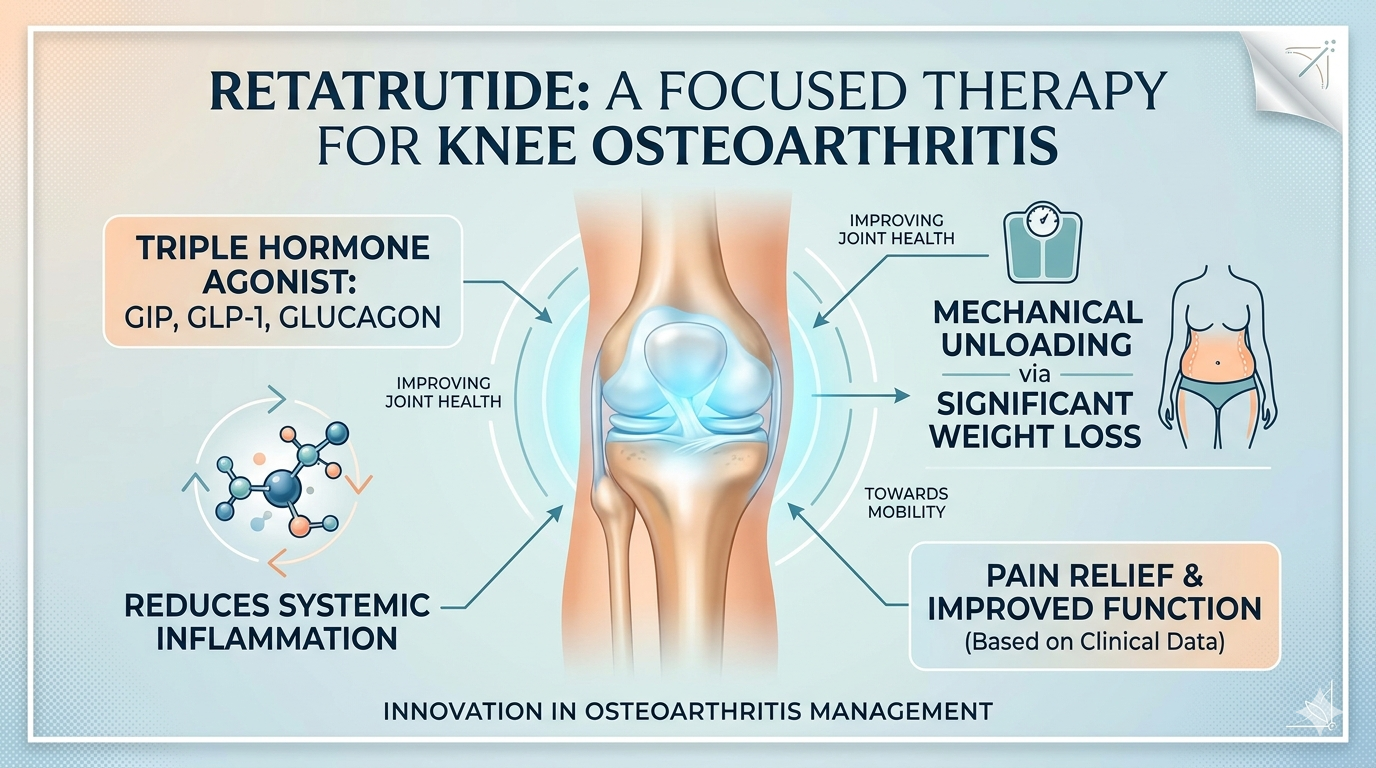
Retatrutide for Knee Osteoarthritis; Last Updated: June 2026

Retatrutide for Knee Osteoarthritis is gaining attention as researchers explore how metabolic therapies can address the underlying drivers of joint degeneration.
By promoting significant weight loss and reducing metabolic dysfunction, Retatrutide may offer a new approach to managing osteoarthritis beyond traditional symptom relief.
According to National Institute of Health, at least 7% of the US population suffers from symptomatic knee osteoarthritis (OA). If the age is considered above 60, the percentage doubles up to 13% of women and 10% of men.
If the percentages are translated into figures, that crosses a mind-boggling 14 to 15 million. A problem that is silently affecting the mobility of a nation.
With traditional medications for knee osteoarthritis like Acetaminophen (e.g., Tylenol), Nonsteroidal Anti-inflammatory Drugs, and NSAID Gels, peptides like retatrutide are also being researched and proven to be effective in recent studies.
This article explains the problem itself and how triple agonists like Retatrutide can help patients with knee osteoarthritis based on international research.
KEY TAKEAWAYS
- Retatrutide is the first triple hormone receptor agonist (GIP + GLP-1 + Glucagon) to complete a Phase 3 trial specifically targeting knee osteoarthritis (OA).
- The TRIUMPH-4 trial showed an average weight loss of 28.7% (71.2 lbs) at 68 weeks in participants taking the 12 mg dose.
- WOMAC pain scores dropped by up to 75.8% — one of the most significant pain reductions ever recorded in an OA drug trial.
- About 1 in 8 retatrutide-treated patients reported being completely free of knee pain by the end of the trial.
- Retatrutide works through two main paths: (1) unloading the joint mechanically via weight loss, and (2) cooling systemic inflammation that destroys cartilage.
- Retatrutide is still an investigational drug. It is not yet FDA-approved. Always consult a qualified medical professional before making any treatment decisions.
- Patients with metabolic-driven OA (obesity + joint pain) are likely the best candidates if the drug receives approval.
- This drug may one day delay or prevent the need for total knee replacement (TKR) surgery in eligible patients.
Knee Pain and Retatrutide How it Started?
Knee pain is one of the most common reasons adults visit a doctor. For decades, we called it ‘wear and tear.’ We told patients to lose weight, take anti-inflammatories, and maybe get cortisone shots. For millions of people, this cycle of temporary relief and ongoing pain defines their daily life.
But the science has shifted. Researchers now understand that knee osteoarthritis (OA) in many patients is not just a mechanical problem, it is a metabolic disease. When someone carries excess body weight, their fat tissue does not just press down on the joint. It also releases inflammatory proteins into the bloodstream that slowly eat away at cartilage from the inside.
This discovery opens a powerful new question: What if we could treat knee OA not with joint injections or pain pills, but by fixing the underlying metabolic problem driving it?
That is exactly what Eli Lilly and Company set out to test with retatrutide and the results from their landmark TRIUMPH-4 clinical trial have turned heads across the world of medicine.
Understanding Knee Osteoarthritis (OA)
Knee osteoarthritis is a progressive disease where the cartilage inside your knee, the slippery cushion between your bones, slowly breaks down. Without that cushion, bones begin to rub against each other, causing pain, stiffness, swelling, and eventually disability.
According to a comprehensive 2024 review published in the journal Therapeutic Advances in Musculoskeletal Disease, knee OA affects approximately 528 million people worldwide and accounts for 2.4% of all years lived with disability globally.
What Happens Inside the Knee?
The Cartilage Matrix: A Slow Collapse
Healthy cartilage is made of two key building blocks: proteoglycans (proteins that hold water and give cartilage its cushioning ability) and collagen fibers (the structural scaffold that keeps cartilage strong and flexible). In OA, enzymes called matrix metalloproteinases (MMPs) and aggrecanases destroy these building blocks faster than the body can repair them. Over time, the cartilage becomes thin, cracked, and rough, leading to the dreaded bone-on-bone friction.
Synovial Inflammation: Where the Pain Comes From
The synovium is the thin tissue lining the inside of your knee joint. When cartilage breaks down, debris particles float into the joint fluid. The synovium detects this and launches an inflammatory response, releasing pain-causing chemicals called cytokines (such as IL-1β, IL-6, and TNF-α). This is why OA pain often flares up after activity and why the joint can feel warm and swollen.
Key Symptoms of Knee OA
- Pain: The classic ‘start-up pain’, stiffness and aching during the first few steps in the morning, or after sitting for a long time. It may ease with movement but return after prolonged activity.
- Morning Stiffness: Unlike rheumatoid arthritis (which causes stiffness lasting more than an hour), OA stiffness typically resolves within 30 minutes.
- Swelling: Fluid buildup inside the joint (called an effusion) causes visible puffiness around the kneecap.
- Crepitus: A grinding, clicking, or crunching sensation when you bend or straighten your knee, caused by roughened cartilage surfaces rubbing together.
- Reduced Range of Motion: Difficulty fully bending or straightening the knee, making activities like climbing stairs, squatting, or rising from a chair increasingly difficult.
- Joint Instability: A feeling of ‘giving way’ as the muscles and ligaments around a damaged knee lose their support role.
Research Spotlight | Dr. Michael Langworthy, Dr. Vinod Dasa, and Dr. Andrew Spitzer, Tulane University School of Medicine / Sage Therapeutics (2024)
A landmark review published in Therapeutic Advances in Musculoskeletal Disease confirmed that knee OA now affects nearly 528 million people globally, including 23% of the world’s population aged 40 and over. The authors emphasized that OA is a leading cause of disability, with pain acting as the primary barrier to physical activity and quality of life. They called for more disease-modifying treatments that address the systemic roots of joint degeneration, not just symptom management.
The Risk Factors: Why Does OA Develop?
Just like any other human health complication, it is quite difficult to attribute a single reason for Knee Osteoarthritis. However, there are some reasons that are found common in most patients.
Age: The Body’s Repair Shop Slows Down
As we age, our cartilage loses its ability to repair itself. Chondrocytes, the cells responsible for maintaining cartilage, become less active and fewer in number. The cartilage becomes drier and more brittle. On top of that, the muscles around the knee lose strength, placing even more stress on the joint surface. Age alone is the single biggest non-modifiable risk factor for knee OA.
Obesity and Mechanical Loading: A Four-to-One Rule
Here is a number that surprises many patients: for every one pound of body weight you carry, the force across your knee joint during walking is multiplied by roughly four pounds. That means a person who is 30 pounds overweight is placing approximately 120 extra pounds of stress on their knees with every step.
This discovery, sometimes called the ‘four-to-one rule’, was established by Professor Stephen P. Messier, PhD, Director of the J.B. Snow Biomechanics Laboratory at Wake Forest University, through decades of clinical research. His groundbreaking IDEA (Intensive Diet and Exercise for Arthritis) trial remains one of the most cited studies in the field.
Research Spotlight | Professor Stephen P. Messier, PhD, J.B. Snow Biomechanics Laboratory, Wake Forest University, Winston-Salem, NC (2022 follow-up to IDEA Trial)
In a long-term follow-up of the IDEA randomized controlled trial (published in Arthritis Care & Research), Messier and colleagues confirmed that participants who lost at least 10% of body weight through combined diet and exercise maintained significant reductions in knee joint compression forces and pain up to 3.5 years after the intervention. This study established one of the strongest evidence bases for weight loss as a disease-modifying intervention in knee OA, not just a pain management tool.
Genetic Influence can Cause Knee Osteoarthritis
Your genes play a real role in OA. If a parent or sibling has knee OA, your own risk increases significantly. Genetics can influence your cartilage composition, the shape of your bones, and how your body responds to inflammation. Specific gene variants affecting collagen structure (like the COL9A1 gene) and cartilage metabolism have been linked to earlier and more severe OA. However, genetics is not destiny, lifestyle factors can powerfully modify your risk, even with a strong family history.
Prior Knee Injuries Makes Knees Prone to Knee Osteoarthritis
An ACL tear, meniscus damage, or major ligament injury dramatically increases the likelihood of developing knee OA earlier in life, sometimes before the age of 40. This is known as post-traumatic osteoarthritis (PTOA). The initial injury disrupts the normal mechanics of the joint, alters cartilage loading patterns, and triggers an inflammatory cascade that accelerates degeneration. Studies show that up to 50% of people who suffer a significant knee injury will develop OA within 10-15 years.
Metabolic Syndrome and Systemic Inflammation May Cause Knee Osteoarthritis
This is the crucial link that brings retatrutide into the story. Researchers now recognize that OA, especially in people with obesity, is not purely a mechanical problem. Excess fat tissue, particularly around the abdomen, functions like a runaway inflammation factory. It releases adipokines such as leptin, resistin, and visfatin that directly damage cartilage cells, even in joints that are not bearing any extra weight (such as the hands or wrists). This explains why OA often develops in multiple joints simultaneously in people with obesity.
Research Spotlight | Dr. Susanne N. Wijesinghe; Institute of Inflammation and Ageing, University of Birmingham, UK (2023)
Dr. Wijesinghe’s research team, funded by Versus Arthritis, published a study in Clinical and Translational Medicine demonstrating for the first time that obesity-related factors actively reprogram synovial fibroblast cells inside the joint into a pro-inflammatory state.
The study showed that metabolic changes caused by excess fat tissue can ‘turn’ otherwise normal joint lining cells into cells that promote cartilage-destroying inflammation, a process that goes far beyond simple mechanical loading. This was a pivotal finding for understanding why obesity-related OA requires metabolic treatment, not just weight reduction.
What is Metabolic therapy or metabolic treatment?
Metabolic therapy encompasses medical interventions designed to address disorders affecting the body’s biochemical processes that convert food into energy and essential molecules. These therapies range from dietary modifications and enzyme replacement to pharmacological treatments, targeting both rare inherited metabolic diseases and common conditions such as diabetes and dyslipidaemia. In the UK, specialist metabolic medicine services coordinate individualised care through multidisciplinary teams, with treatment plans tailored to each patient’s specific metabolic defect. Early diagnosis and prompt intervention can prevent irreversible complications, particularly neurological damage, making metabolic therapy a vital component of NHS care for thousands of patients.
Source- Bolt Pharmacy, What Is Metabolic Therapy? UK Treatment Options Explained, Published on 17th April 2026
The growing understanding that metabolic dysfunction contributes directly to knee osteoarthritis has shifted attention toward therapies that target these underlying metabolic pathways. One of the most promising investigational treatments in this area is Retatrutide, a next-generation triple hormone receptor agonist.
What Is Retatrutide?
Retatrutide (also called LY3437943) is an investigational once-weekly injectable medication that activates three hormone receptors at once: GIP, GLP-1, and Glucagon. Because of this ‘triple action,’ it is called a Triple-G agonist. It produces significantly greater weight loss than any previously approved weight-loss medication.
The Science of Retatrutide: Decoding the ‘Triple-G’ Mechanism
To understand why retatrutide is so exciting, you need to understand how it is different from drugs you may have already heard about, like semaglutide (Ozempic/Wegovy) or tirzepatide (Mounjaro/Zepbound).
GLP-1 Agonism: The Foundation
GLP-1 (glucagon-like peptide-1) is a hormone released in your gut after eating. It signals your brain to feel full, slows stomach emptying, and controls blood sugar. Drugs like semaglutide mimic this single hormone. They produce meaningful weight loss, roughly 10-15% of body weight. That is significant, but it is only the first layer of what retatrutide does.
GIP Agonism: Supercharging Weight Loss
GIP (glucose-dependent insulinotropic polypeptide) is another gut hormone that, when activated alongside GLP-1, dramatically amplifies satiety signals. Tirzepatide (a dual GLP-1/GIP agonist) showed that adding GIP to GLP-1 could push weight loss to around 20-22%. Retatrutide adds this second layer.
Glucagon Agonism: Burning the Fat
Glucagon is the third hormone in retatrutide’s arsenal. Normally, glucagon raises blood sugar by triggering the liver to release stored glucose. But at the carefully calibrated doses used in retatrutide, activating the glucagon receptor does something remarkable: it increases the body’s metabolic rate, meaning the body burns more calories at rest, and it enhances fat breakdown (lipolysis). This third mechanism is what makes retatrutide uniquely powerful. By combining all three, retatrutide suppresses appetite from multiple angles while simultaneously making the body a more efficient fat-burning machine.
Why Triple-G Beats Single-G: The Simple Version
Think of GLP-1 as putting the brakes on your hunger, GIP as making those brakes stronger, and Glucagon as pressing the gas on your metabolism at the same time. Single drugs only do one thing. Retatrutide does all three simultaneously, which is why it achieves weight loss levels never seen before in a clinical trial.
The TRIUMPH-4 Clinical Trial: Breaking Down the Evidence
In December 2025, Eli Lilly and Company announced positive top-line results from TRIUMPH-4, the first Phase 3 clinical trial specifically designed to evaluate retatrutide in people with obesity and knee OA. The results were, by most measures, historic.
Trial Design and Methodology
- Trial Type: Phase 3, randomized, double-blind, placebo-controlled (the highest level of clinical evidence)
- Duration: 68 weeks (approximately 16 months)
- Participants: 445 adults with obesity or overweight AND moderate-to-severe knee osteoarthritis, without type 2 diabetes
- Average Baseline Profile: Body weight of 112.7 kg (248.5 lbs), BMI of 40.4 kg/m², and WOMAC pain score of 6.0 points
- Groups: Retatrutide 9 mg (once-weekly injection), Retatrutide 12 mg (once-weekly injection), and Placebo
- Primary Endpoints: Percentage change in body weight AND change in WOMAC pain subscale score, measured simultaneously
What Is the WOMAC Score?
WOMAC stands for the Western Ontario and McMaster Universities Osteoarthritis Index. It is the gold standard patient-reported outcome tool for measuring knee OA severity. It scores pain (0-10 scale), stiffness, and physical function. A higher score means more pain and disability. A reduction of even 1.5-2.0 points on the pain subscale is considered clinically meaningful. Keep that benchmark in mind when reading the results below.
Key Findings
| Outcome Measure | Result | Clinical Significance |
|---|---|---|
| Average Body Weight Loss (Week 68) | 28.7% | Equivalent to approximately 71.2 lbs (32.3 kg) lost at the 12 mg dose. |
| Reduction in WOMAC Pain Score | 75.8% | Up to a 4.5-point reduction from a baseline score of 6.0, indicating substantial improvement in knee osteoarthritis pain. |
| Patients Reporting No Knee Pain | 1 in 8 patients | Approximately 12.5% of retatrutide-treated participants reported being completely free of knee pain by Week 68. |
Both the 9 mg and 12 mg doses met all primary and key secondary endpoints. For context, most approved OA pain medications achieve WOMAC pain reductions of 1.0 to 2.0 points. A 4.5-point reduction, achieved through a metabolic drug rather than a joint-targeted one, is genuinely remarkable.
Additionally, retatrutide improved multiple cardiometabolic markers alongside joint health, including reductions in non-HDL cholesterol, triglycerides, and systolic blood pressure.
Research Spotlight | Dr. Kathryn Giblin, Dr. Lee M. Kaplan, Dr. Virend K. Somers, Dr. David J. Hunter et al. Eli Lilly & Co. / Obesity and Metabolism Institute, Boston / Mayo Clinic / University of Sydney (2025)
The TRIUMPH trial design paper, published in Diabetes, Obesity and Metabolism (October 2025), laid out the scientific rationale for studying retatrutide specifically in patients with obesity and knee OA. The authors, led by Giblin and including OA specialist Professor David J. Hunter from the University of Sydney and Dr. Virend Somers from the Mayo Clinic, argued that the metabolic mechanisms driving obesity-related OA make it an ideal target for triple-hormone receptor agonism, and that WOMAC scores alongside weight data would be the appropriate dual-primary endpoint framework.
How Retatrutide Restores the Knee: Beyond the Scale
While weight loss is one of the most effective ways to reduce stress on arthritic knees, emerging research suggests that the benefits of Retatrutide may extend beyond the number on the scale.
By targeting metabolic dysfunction, inflammation, and obesity-related biological pathways, Retatrutide has the potential to address several underlying factors that contribute to the development and progression of knee osteoarthritis.
Unloading the Joint: The Mechanical Benefit
The most immediate benefit of significant weight loss for a knee OA patient is purely physical. Using the four-to-one rule: losing 71 pounds (as the average 12 mg participant did in TRIUMPH-4) translates to approximately 284 fewer pounds of force across the knee joint with every single step. Over a typical day of walking, this reduction in cumulative joint loading is enormous, and it gives cartilage the breathing room it needs to survive and potentially begin limited self-repair.
The Cooling Effect: Turning Off the Inflammation Factory
Perhaps even more important than the mechanical benefit is the anti-inflammatory benefit. As body fat decreases — particularly visceral fat (the deep abdominal fat most metabolically active) — the production of pro-inflammatory adipokines drops significantly. Levels of leptin and resistin fall. Adiponectin (a protective, anti-inflammatory adipokine) rises. The result is a dramatic reduction in the systemic inflammatory signals reaching the knee joint.
Less inflammation means fewer cartilage-destroying enzymes (MMPs). Additionally, less synovial activation. Less joint swelling. This ‘cooling effect’ is the molecular explanation behind the extraordinary 75.8% WOMAC pain reduction seen in TRIUMPH-4.
Restored Mobility and Muscle Support
When knee pain decreases and patients can move more comfortably, a virtuous cycle begins. People become more physically active. They begin to rebuild the quadriceps and hamstring muscles that serve as the primary shock absorbers protecting the knee. Stronger surrounding muscles further reduce the load on the joint surface, producing additional pain relief and functional improvement beyond what weight loss alone achieves.
This chain reaction- weight loss → less pain → more activity → stronger muscles → less joint load, is exactly what researchers observed in TRIUMPH-4, where improvements in physical function scores tracked closely with weight loss and pain reduction.
The Dual Mechanism Advantage of Retatrutide in OA Treatment
Most OA treatments are either mechanical (injections, surgery) or anti-inflammatory (NSAIDs, corticosteroids). Retatrutide achieves BOTH simultaneously, unloading the joint through weight loss while cooling the systemic inflammation that destroys cartilage. This dual mechanism is unprecedented in OA pharmacology.
Research Spotlight | Dr. Maximilian T. Löffler, Dr. Nancy E. Lane, Dr. Thomas M. Link et al. University of California San Francisco (UCSF) / Technical University Munich, Osteoarthritis Initiative (2024)
A 2024 study published in BMC Musculoskeletal Disorders, using data from the Osteoarthritis Initiative cohort of 4,796 participants, demonstrated that weight loss was directly associated with a measurable reduction in knee joint synovitis (inflammation of the joint lining) over a 48-month follow-up period. Critically, the study identified that subcutaneous fat located around the knee itself acted as a local mediator of this effect, suggesting that the fat loss retatrutide produces may have both systemic and local anti-inflammatory effects on the joint.
Current Treatments for Knee OA: Where Retatrutide Fits In?
Understanding why retatrutide matters requires knowing the limitations of what we currently have. Despite knee OA affecting hundreds of millions of people, the treatment landscape remains largely symptom-focused. There are currently no FDA-approved disease-modifying osteoarthritis drugs (DMOADs), meaning no approved drug can actually slow or reverse cartilage damage.
Current Standard of Care
- Lifestyle modifications: Weight loss, exercise, physical therapy, effective but difficult to sustain long-term for many patients.
- Pain medications: Acetaminophen, NSAIDs (ibuprofen, naproxen) manage symptoms but carry risks (GI bleeding, cardiovascular effects) with long-term use.
- Intra-articular injections: Corticosteroids provide short-term pain relief; hyaluronic acid (viscosupplementation) has mixed evidence.
- Duloxetine (Cymbalta): An antidepressant repurposed for chronic musculoskeletal pain, modest benefits.
- Total knee replacement (TKR): The endpoint for severe OA, highly effective but is major surgery with significant recovery time and risks.
The gap between ‘pain medications’ and ‘joint replacement surgery’ represents a massive unmet medical need. Retatrutide, if approved, could occupy that middle ground, a biologically active intervention that treats the metabolic root cause, potentially delaying or preventing the need for surgery in appropriately selected patients.
How Retatrutide Compares to Other GLP-1-Class Drugs for OA?
Semaglutide has shown benefits for knee OA pain in its STEP 9 trial (KOMET), but its mechanism is primarily through weight loss alone (GLP-1 only). Tirzepatide (dual GIP/GLP-1) is also being studied. Retatrutide’s triple mechanism appears to produce greater weight loss, and correspondingly greater joint pain relief, than either predecessor. The 75.8% WOMAC pain reduction in TRIUMPH-4 exceeds what has been observed with semaglutide or tirzepatide in OA-specific trials to date.
Safety Profile and Patient Selection When Using Retatrutide
Like all medications, Retatrutide is not suitable for everyone and should be used under appropriate medical supervision. Understanding its safety profile, potential side effects, and the types of patients who may benefit most is essential for making informed treatment decisions.
The Safety Profile: What to Expect
The overall safety profile of retatrutide in TRIUMPH-4 was consistent with the incretin class of medications. Most side effects are manageable and resolve over time.
Common Side Effects (Gastrointestinal)
As with all GLP-1-based medications, the most common side effects are gastrointestinal: nausea, vomiting, diarrhea, and constipation. These are most pronounced during the dose escalation phase (the first several weeks) and typically decrease once the patient reaches their maintenance dose. Gradual dose increases are used specifically to minimize these effects.
Dysesthesia: A Notable Finding
One side effect that appeared in TRIUMPH-4 at a higher rate than in earlier trials was dysesthesia, abnormal, unpleasant sensory changes such as tingling, burning, or numbness, typically in the extremities. According to the trial data, these events were generally mild in severity and rarely led to treatment discontinuation. However, they are being carefully monitored as the trial data undergoes full peer review. This finding warrants attention in future studies and in clinical practice if the drug is approved.
Other Monitoring Points
- Heart rate increases: GLP-1/glucagon agonists can slightly elevate resting heart rate. Cardiac monitoring is standard protocol.
- Gallbladder events: Rapid weight loss (as achieved with retatrutide) can increase the risk of gallstones. Patients should be monitored.
- Muscle mass: Very rapid weight loss can include loss of muscle (lean mass) alongside fat. Combination with resistance exercise is recommended.
- Nausea management: Eating smaller meals, avoiding high-fat foods, and taking the injection with food can reduce GI side effects.
Who Is the Right Patient?
Not every person with knee OA is an ideal candidate for retatrutide and understanding the distinction is medically important.
Most Likely to Benefit: Metabolic-Driven OA
The ideal retatrutide candidate has: knee OA with a significant obesity component (BMI ≥30, especially ≥35), systemic inflammatory markers (elevated CRP, adipokine levels), multiple joint involvement suggesting a metabolic driver, and no type 2 diabetes (based on current trial population) though future trials may expand this.
Less Likely to Benefit: Structural or Post-Traumatic OA
Patients whose knee OA stems primarily from a prior injury (ACL tear, meniscus damage), severe structural bone deformity, or a normal BMI are unlikely to experience the same dramatic benefits. For them, the root cause is mechanical or anatomical, not metabolic, and the drug’s mechanism of action does not address that pathway.
Important Medical Disclaimer
Retatrutide is currently an INVESTIGATIONAL drug. It has NOT been approved by the FDA or any other regulatory body for the treatment of knee osteoarthritis or any other condition as of this publication. The information in this article is based on publicly announced clinical trial results and peer-reviewed literature. It is not intended as medical advice. Please consult a licensed healthcare professional before making any treatment decisions.
The Science Supporting Metabolic OA Treatment
The TRIUMPH-4 results do not exist in isolation. Over the past five years, a growing body of peer-reviewed research has built the scientific foundation that makes these results understandable and credible. Here is a summary of five key studies you should know:
Research Spotlight | Associate Professor Christina Abdel Shaheed and Dr. Vicky Duong, Sydney Musculoskeletal Health, Faculty of Medicine and Health, University of Sydney (2025)
A landmark meta-analysis published in Osteoarthritis and Cartilage (2025) analyzed 131 studies covering over 150 risk factors for knee OA in participants ranging from 20 to 80 years old. The University of Sydney team confirmed that obesity is one of the most powerful and modifiable risk factors for developing knee OA, and that addressing it through weight loss or dietary change could meaningfully reduce population-level OA incidence. This study provided the clearest large-scale confirmation that obesity is a causal driver of knee OA, not merely an associated condition.
This growing body of research makes a compelling scientific case: retatrutide for knee osteoarthritis is not a coincidental application of a weight-loss drug. It is a targeted, evidence-driven strategy to address the metabolic root causes of the disease.
The Future of Metabolic Rheumatology
Could Retatrutide Prevent Total Knee Replacement?
Total knee replacement (TKR) is a highly effective surgery, but it is also expensive, requires significant recovery time, carries procedural risks, and implants have a lifespan of 15-20 years. For younger patients with severe OA, this means potentially needing a revision surgery later in life. Any drug that can slow or halt OA progression in metabolic patients could delay or, in some cases, eliminate the need for TKR.
Based on the TRIUMPH-4 results, where 1 in 8 patients reported complete freedom from knee pain, this is not merely speculative. Longer follow-up studies will be critical in determining whether the structural benefits (cartilage preservation) match the symptomatic benefits (pain reduction) observed so far.
The Broader TRIUMPH Program
TRIUMPH-4 was the first of multiple Phase 3 trials to report. Seven additional Phase 3 trials are expected to report results in 2026, including studies in obesity alone, type 2 diabetes, obstructive sleep apnea, chronic low back pain, metabolic fatty liver disease, and cardiometabolic outcomes. If approved across these indications, retatrutide would become one of the most broadly impactful metabolic drugs in medical history.
Metabolic Rheumatology: A New Discipline
The TRIUMPH-4 results represent more than a drug approval. They represent a paradigm shift in how we think about musculoskeletal disease. The concept of ‘metabolic rheumatology’, treating joint disease through metabolic intervention, is likely to reshape clinical guidelines, training programs, and the specialty boundaries between endocrinology, rheumatology, and orthopedic surgery in the coming decade.
For patients, this means that a visit to a weight-management specialist could one day be just as important for their joint health as a visit to their orthopedic surgeon. The two disciplines are no longer separate.
What Patients Should Know About Retatrutide and knee OA Right Now
- Do not wait for FDA approval to begin addressing the metabolic drivers of your knee OA. Weight loss, even modest amounts, has proven benefits for joint pain.
- Speak to your doctor about your eligibility for existing GLP-1 therapies if you have obesity and knee OA, as evidence is building for this class.
- Stay informed about retatrutide’s regulatory pathway. Full peer-reviewed data from TRIUMPH-4 will be presented at a future medical conference and published in a peer-reviewed journal, watch for those findings.
- If you have had a prior knee injury, do not assume retatrutide is the right tool for you, the mechanism is designed for metabolic-driven OA, not structural damage.
- Combine whatever medical interventions you use with low-impact exercise (swimming, cycling, water aerobics) and quadriceps-strengthening work, these have independent, additive benefits for knee OA.
Moving Upstream Against a Degenerative Disease
For generations, medicine has been playing catch-up with knee osteoarthritis. Treatment often begins only after significant pain and joint damage have occurred. Short-term symptom management and surgery remain the primary approaches, despite growing evidence that earlier intervention could prevent or slow disease progression in many patients.
Retatrutide for knee osteoarthritis represents a fundamentally different approach, one that moves upstream, targeting the metabolic forces that set cartilage destruction in motion before the patient is limping into an orthopedic clinic.
The TRIUMPH-4 results, a 28.7% reduction in body weight and a 75.8% reduction in WOMAC pain scores, are not just impressive numbers. They are proof of concept for an entirely new way of thinking about joint disease.
They say: the knee does not degenerate in isolation. The knee suffers the consequences of what happens in the liver, the fat cells, the bloodstream, and the gut. Fix those, and the knee begins to heal.
We Are at The Very Beginning
Retatrutide still requires full regulatory review and approval. Long-term structural data is needed. But the direction is clear, and the results are real. The future of rheumatology has a metabolic heartbeat.
Key References:
- Eli Lilly and Company. TRIUMPH-4 Phase 3 Top-Line Results. Press Release, December 11, 2025.
- Giblin K, Kaplan LM, Somers VK, et al. Retatrutide for the treatment of obesity, OSA and knee OA: Rationale and design of TRIUMPH trials. Diabetes Obes Metab. 2026;28(1):83-93.
- Messier SP, et al. Changes in body weight and knee pain 3.5 years after diet and exercise interventions. Arthritis Care & Research. 2022.
- Wijesinghe SN, et al. Obesity-driven synovial fibroblast reprogramming in OA. Clinical and Translational Medicine. 2023.
- Löffler MT, Lane NE, Link TM, et al. Effect of weight loss on knee joint synovitis over 48 months. BMC Musculoskeletal Disorders. 2024.
- Abdel Shaheed C, Duong V, et al. Obesity a leading cause of knee osteoarthritis: a meta-analysis of 131 studies. Osteoarthritis and Cartilage. 2025.
- Langworthy M, Dasa V, Spitzer AI. Knee osteoarthritis: disease burden, available treatments, and emerging options. Therapeutic Advances in Musculoskeletal Disease. 2024.
- Adouni M, et al. Effect of body weight on knee joint biomechanics. Scientific Reports. 2024.
Medical Disclaimer & References
This article is for educational purposes only and is based on verified, publicly available clinical trial results, peer-reviewed literature, and institutional research findings as of June 2026. Retatrutide is an investigational drug and is NOT approved for clinical use by the FDA or other major regulatory agencies. No information in this article constitutes medical advice. Always consult a qualified healthcare professional.
Leave a Reply